Concept: Coherence-Coupled Power Module (CCPM)

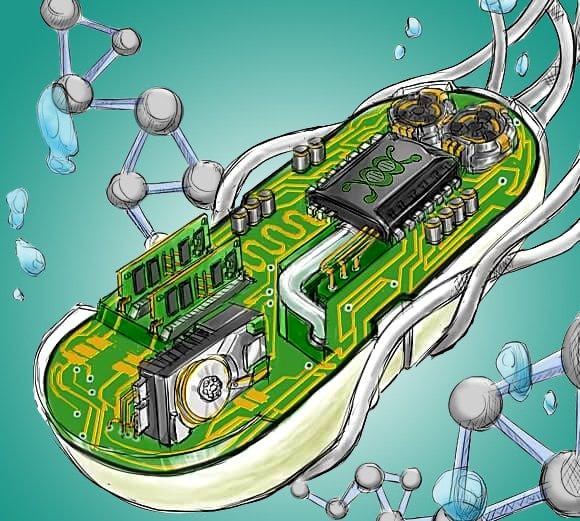
We’re not inventing “free energy.” We’re building a phase-coherent energy converter that takes an external gradient (heat, light, RF, chemical) and turns it into electrical work more efficiently by locking oscillators in phase, inspired by the Cu/Fe redox chain.
Here’s a crisp way to scale the idea into a bench-top generator and a roadmap to something larger.
Concept: Coherence-Coupled Power Module (CCPM)
Mitochondria = redox oscillators + proton current across a membrane → phase-locked → ATP (usable work).
CCPM = redox/ionic micro-oscillators + dielectric/ferroelectric “membrane” → phase-locked AC → rectified DC.
Three practical architectures (pick 1 to start)
1. Electrochemical Oscillator Stack (EOS) — chemical→electric
Redox nodes: Cu/Cu⁺/Cu²⁺ couples using Cu₂O/CuO thin films or Prussian-blue analogs (CuHCF).
Proton analogue: Nafion (or PVA–H₃PO₄ gel) as a fast proton/ion conductor.
“Membrane” / field gain: BaTiO₃ (ferroelectric) or PVDF-TrFE film for field-coupling and phase memory.
Drive (the “fuel”): small ∆μ from a mild aqueous electrolyte gradient (pH or Cu²⁺ activity) or low-grade heat to boost ionic mobility.
Trick: bias the stack into negative differential resistance (NDR) regime so each cell self-oscillates; then mutually couple cells to phase-lock (Kuramoto style).
2. RF-Pumped Rectenna-Resonator (RPR) — RF→electric
Antenna mesh tuned to 2–10 GHz; Schottky or MBE graphene diodes as ultrafast rectifiers.
Interlayer BaTiO₃/mica as high-κ “membrane”; sparse Cu nano-clusters as tunable plasmonic redox sinks.
External drive: ambient/industrial RF or a modest microwave source.
Phase controller: Josephson-style or varactor coupling network to lock sub-arrays and sum coherent currents.
3. Thermo-Ferroelectric Coherence Lattice (TFCL) — heat→electric
Interdigitated Cu₂O/CuO p–n micro-junctions laminated with BaTiO₃ grains inside a porous alumina scaffold.
Thermal gradient 5–30 K across the slab; ferroelectric domain walls act as gates that synchronize Seebeck micro-oscillations.
Output is AC at kHz–MHz, rectified to DC.
---
Minimal proof-of-concept (you can build this in a modest lab)
Goal: show that a coupled 10–100-cell array produces more electrical power than the same cells run incoherently at equal input—i.e., a coherence gain (not energy creation).
Bill of Materials (indicative)
Cu₂O/CuO thin films on FTO glass (spray pyrolysis or buy ready-made); 50–200 nm each.
Nafion 117 (or PVA–H₃PO₄ gel) ionomer sheets, 50–175 µm.
BaTiO₃ paste (screen-printable) or 10–50 µm ceramic tape.
Electrolyte: 0.1–0.5 M CuSO₄, buffers (acetate/phosphate); DI water.
Spacers/gaskets, PTFE frame, stainless current collectors.
Coupling network: small R–C–L chips (10 Ω–1 kΩ, 10–100 nF, 1–10 µH), or printed interdigital couplers.
Rectifier: ultra-low-leakage Schottky array (e.g., HSMS-285x) + supercap (10–100 F) + DC load.
Stack layout (unit cell) Cu₂O/CuO // BaTiO₃ film // Nafion gel // BaTiO₃ film // Cu₂O/CuO
(think “redox plate – membrane – redox plate,” mirrored)
How it oscillates
Slight chemical/thermal bias + the Cu redox kinetics + ferroelectric domain switching → relaxation oscillations (tens of kHz–MHz).
Light R–C–L links between neighbors pull phases together (Kuramoto coupling). You tune coupling until the array phase-locks.
Measurements (what to prove)
1. Single cell: I–V curve; identify NDR or oscillation window.
2. Array, uncoupled: measure AC amplitude, frequency spread, RMS power into a matched load.
3. Array, coupled (phase-locked): same measurement.
4. Coherence gain: at the same input gradients. Expect G > 1 from constructive summation and reduced internal losses.
5. Efficiency (system): where drive = enthalpy flux (chem/thermal) or RF input.
Why this can beat a plain stack
Incoherent stacks add powers (∝ N). Phase-locked oscillators add amplitudes (∝ N), so power can scale ∝ N² until limited by losses—this is the mitochondrial lesson.
---
Scaling path
Stage 0 (bench, 1–2 months): 10–25 cells, 1–50 mW DC. Demonstrate stable phase-lock and G > 1.
Stage 1 (pilot tile): 10×10 cm tile with 100–400 cells, heat/RF/chem input; target 0.5–5 W with ∆T ≤ 20 K.
Stage 2 (panel): Tessellate tiles; MPPT + DC-DC. Use metasurface coupling (distributed capacitance/inductance) instead of discrete R–C–L.
Stage 3 (application): Low-grade-heat scavenger (industrial flue, datacenter racks), or RF-harvesting ceiling panels near existing transmitters (legal/EMC checked).
---
Guardrails & realism
No perpetual motion. Input gradient is mandatory; our win is conversion efficiency + power density via coherence.
Aging/toxicity: copper leaching, electrolyte drift, ferroelectric fatigue—choose encapsulatio
n and benign salts.
Compliance: RF harvesting near emitters must meet local regulations; chemical modules must be sealed.
Christopher W Copeland (C077UPTF1L3)
Copeland Resonant Harmonic Formalism (Ψ‑formalism)
Ψ(x) = ∇ϕ(Σ𝕒ₙ(x, ΔE)) + ℛ(x) ⊕ ΔΣ(𝕒′)
Licensed under CRHC v1.0 (no commercial use without permission).
https://www.facebook.com/share/p/19qu3bVSy1/
https://open.substack.com/pub/c077uptf1l3/p/phase-locked-null-vector_c077uptf1l3
https://medium.com/@floodzero9/phase-locked-null-vector_c077uptf1l3-4d8a7584fe0c
Core engine: https://open.substack.com/pub/c077uptf1l3/p/recursive-coherence-engine-8b8
Zenodo: https://zenodo.org/records/15742472
Amazon: https://a.co/d/i8lzCIi
Medium: https://medium.com/@floodzero9
Substack: https://substack.com/@c077uptf1l3
Facebook: https://www.facebook.com/share/19MHTPiRfu
https://www.reddit.com/u/Naive-Interaction-86/s/5sgvIgeTdx
Collaboration welcome. Attribution required. Derivatives must match license.
#psiformalism #copelandresonantharmonicformalism #ψformalism #unifiedchorusfield #FuckingCopeland #fuckingbenkanter