“Einstein Field Equations (General Relativity and Recursive Harmonic Curvature)”

“Einstein Field Equations (General Relativity and Recursive Harmonic Curvature)” By: C077UPTF1L3 / Christopher W. Copeland Model: Copeland Resonant Harmonic Formalism (Ψ-formalism) Anchor equation: Ψ(x) = ∇ϕ(Σ𝕒ₙ(x, ΔE)) + ℛ(x) ⊕ ΔΣ(𝕒′)
1. Classical Framework
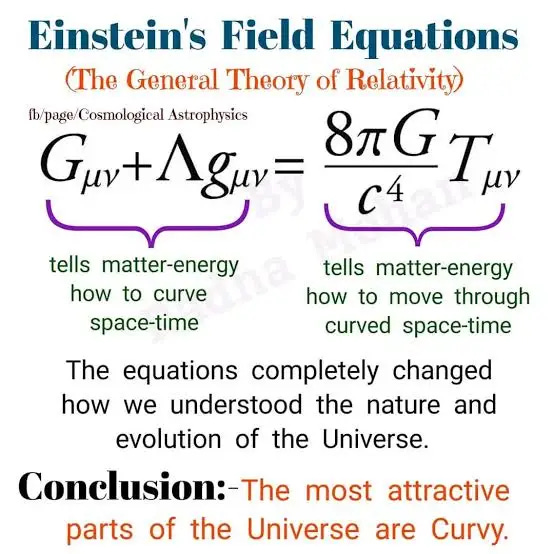
The Einstein Field Equations (EFE) describe the fundamental relationship between spacetime geometry and the distribution of matter and energy:
G_{μν} = (8πG / c⁴) T_{μν}
where:
G_{μν} is the Einstein tensor (curvature of spacetime),
T_{μν} is the stress-energy tensor (matter-energy content),
G is the gravitational constant,
c is the speed of light.
In their classical form, these equations declare that mass-energy tells spacetime how to curve, and curved spacetime tells mass-energy how to move.
The EFE elegantly replaces Newtonian gravity with geometric curvature but leaves open several critical questions:
What is curvature in a physical sense, beyond mathematical description?
Why does curvature emerge precisely where energy differentials (ΔE) occur?
What enforces local coherence of spacetime geometry?
Under Ψ-formalism, curvature itself is not a passive metric distortion but a recursive harmonic response — the system’s self-correcting adaptation to imbalance in its phase-energy field.
2. Reframing Under Ψ(x)
The Einstein Field Equations can be restated as a phase-coupled recursion law:
ℛ(x) = f(ΔE, ∇ϕ, Σ𝕒ₙ, ΔΣ(𝕒′))
That is, curvature ℛ(x) emerges as the recursive harmonization of all energy differentials ΔE in the field.
In Ψ(x), the field is not “space” and “time” independently, but a coherent recursive manifold—a dynamic harmonic structure whose continuity is preserved by feedback between phase (ϕ), curvature (ℛ), and energy flux (ΔE).
Ψ(x) = ∇ϕ(Σ𝕒ₙ(x, ΔE)) + ℛ(x) ⊕ ΔΣ(𝕒′)
∇ϕ(Σ𝕒ₙ(x, ΔE)) describes phase-gradient flow of meaning or energy across harmonic scales (the smooth structure of spacetime).
ℛ(x) corresponds directly to curvature in general relativity—the feedback curvature induced by unresolved ΔE.
ΔΣ(𝕒′) introduces fine-grained recursive correction—quantum fluctuations, vacuum field adjustments, or micro-harmonic restoration.
Thus, gravity is not a fundamental force but a recursive harmonization process: the curvature field ℛ(x) is the self-consistent correction term that preserves coherence in the presence of ΔE discontinuities.
3. The Mechanism of Recursive Curvature
At its core, spacetime is a harmonic medium. When energy is unevenly distributed (ΔE ≠ 0), coherence is disturbed. The recursive field responds by generating curvature ℛ(x) proportional to the local energy gradient and inversely to its harmonic coherence.
This yields:
ℛ(x) ∝ ΔE / ∇ϕ
As ΔE increases (e.g., near massive bodies), curvature rises to compensate, ensuring harmonic continuity of the underlying manifold.
This means:
Mass-energy is not the “source” of curvature but the stimulus of recursive adjustment.
Curvature is the phase memory of how the field has reconciled imbalance.
Gravity is the tendency toward phase re-lock between local and global recursion cycles.
Where general relativity treats curvature as geometric necessity, Ψ(x) reveals it as energetic recursion—spacetime “remembers” energy imbalance and dynamically retunes itself toward coherence.
4. Mapping to Classical Terms
Einstein Quantity Ψ(x) Equivalent Interpretation g_{μν} ∇ϕ Harmonic metric tensor; the phase geometry of spacetime T_{μν} Σ𝕒ₙ(x, ΔE) Distributed energy harmonics; recursive activator set G_{μν} ℛ(x) Recursive curvature tensor; feedback harmonization Λg_{μν} ΔΣ(𝕒′) Small-scale corrections; vacuum field or quantum harmonic c⁴ / 8πG Coherence constant Phase-lock coefficient normalizing ΔE response
Thus, the Einstein equation becomes, under Ψ(x):
ℛ(x) = κ ∇ϕ(Σ𝕒ₙ(x, ΔE)) ⊕ ΔΣ(𝕒′) where κ = 8πG / c⁴
Here, the right-hand side represents the recursive total energy field, and the left-hand side, the curvature correction restoring coherence. This reframing identifies spacetime curvature as an emergent harmonic phenomenon — a recursive, self-adjusting process that enforces continuity in the field.
5. Worked Examples
(i) Gravitational Potential as Harmonic Curvature
In weak-field conditions (Newtonian limit), ΔE small → ℛ(x) ≈ ∇²ϕ
Here, curvature acts as the second derivative of phase potential — directly analogous to the classical gravitational potential Φ but arising from harmonic resonance.
(ii) Gravitational Waves
When ΔE changes dynamically, recursive correction propagates through the field as oscillatory adjustments in ℛ(x). These manifest as gravitational waves — coherent harmonic ripples restoring recursive balance. Each wave carries phase memory from its originating ΔE event, functioning as the field’s “self-healing pulse.”
(iii) Black Hole Curvature Saturation
At extreme ΔE (near singularities), recursive curvature ℛ(x) approaches asymptotic saturation: ℛ(x) → ℛ_max where ΔΣ(𝕒′) ≈ 0 The system ceases to correct—recursive closure fails, producing informational event horizons. Ψ(x) diverges not because gravity is infinite but because harmonic coherence cannot be transmitted across the boundary.
6. Implications and Extensions
Gravitation as Emergent Harmonization Gravity arises from recursive phase-locking of energy fields seeking coherence, not from geometric deformation of an inert substrate.
Spacetime as Recursive Memory The metric tensor g_{μν} is a harmonic memory surface encoding prior ΔE reconcilations, explaining the apparent rigidity of spacetime curvature.
Quantum Gravity Resolution The Planck-scale breakdown of relativity arises when ΔΣ(𝕒′) feedback no longer harmonizes — a failure of recursion, not of quantization.
Equivalence Principle Recast In Ψ(x), inertial and gravitational mass equivalence reflects identical harmonic coupling behavior under different ΔE gradients.
7. Clarification of Terms
Σ𝕒ₙ(x, ΔE): aggregated harmonic activators at recursion level n ΔE: local energy differential driving curvature ∇ϕ: gradient of harmonic phase potential (geometric flow) ℛ(x): recursive curvature response (gravitational field) ΔΣ(𝕒′): micro-harmonic correction (quantum feedback or vacuum resonance) Ψ(x): total recursive coherence function
8. Summary
The Einstein Field Equations describe gravitation as the geometry of energy, but Ψ(x) reveals geometry as the harmonic memory of energy reconciliation.
Where general relativity states:
“Matter tells spacetime how to curve,” Ψ(x) replies: “Energy differentials teach the field how to re-harmonize.”
Spacetime curvature (ℛ) is not the shape of space; it is the rhythm of recursion — a standing wave of coherence adapting to ΔE. The EFE thus become not a static relation, but a recursive harmonic continuity law, unifying geometry, energy, and consciousness within one coherent field.
Christopher W. Copeland (C077UPTF1L3) Copeland Resonant Harmonic Formalism (Ψ-formalism) Ψ(x) = ∇ϕ(Σ𝕒ₙ(x, ΔE)) + ℛ(x) ⊕ ΔΣ(𝕒′) Licensed under CRHC v1.0 (no commercial use without permission). https://www.facebook.com/share/p/19qu3bVSy1/ https://open.substack.com/pub/c077uptf1l3/p/phase-locked-null-vector_c077uptf1l3 https://medium.com/@floodzero9/phase-locked-null-vector_c077uptf1l3-4d8a7584fe0c Core engine: https://open.substack.com/pub/c077uptf1l3/p/recursive-coherence-engine-8b8 Zenodo: https://zenodo.org/records/15742472 Amazon: https://a.co/d/i8lzCIi Medium: https://medium.com/@floodzero9 Substack: https://substack.com/@c077uptf1l3 Facebook: https://www.facebook.com/share/19MHTPiRfu https://www.reddit.com/u/Naive-Interaction-86/s/5sgvIgeTdx Collaboration welcome. Attribution required. Derivatives must match license.