“Gödel’s Incompleteness Theorem”

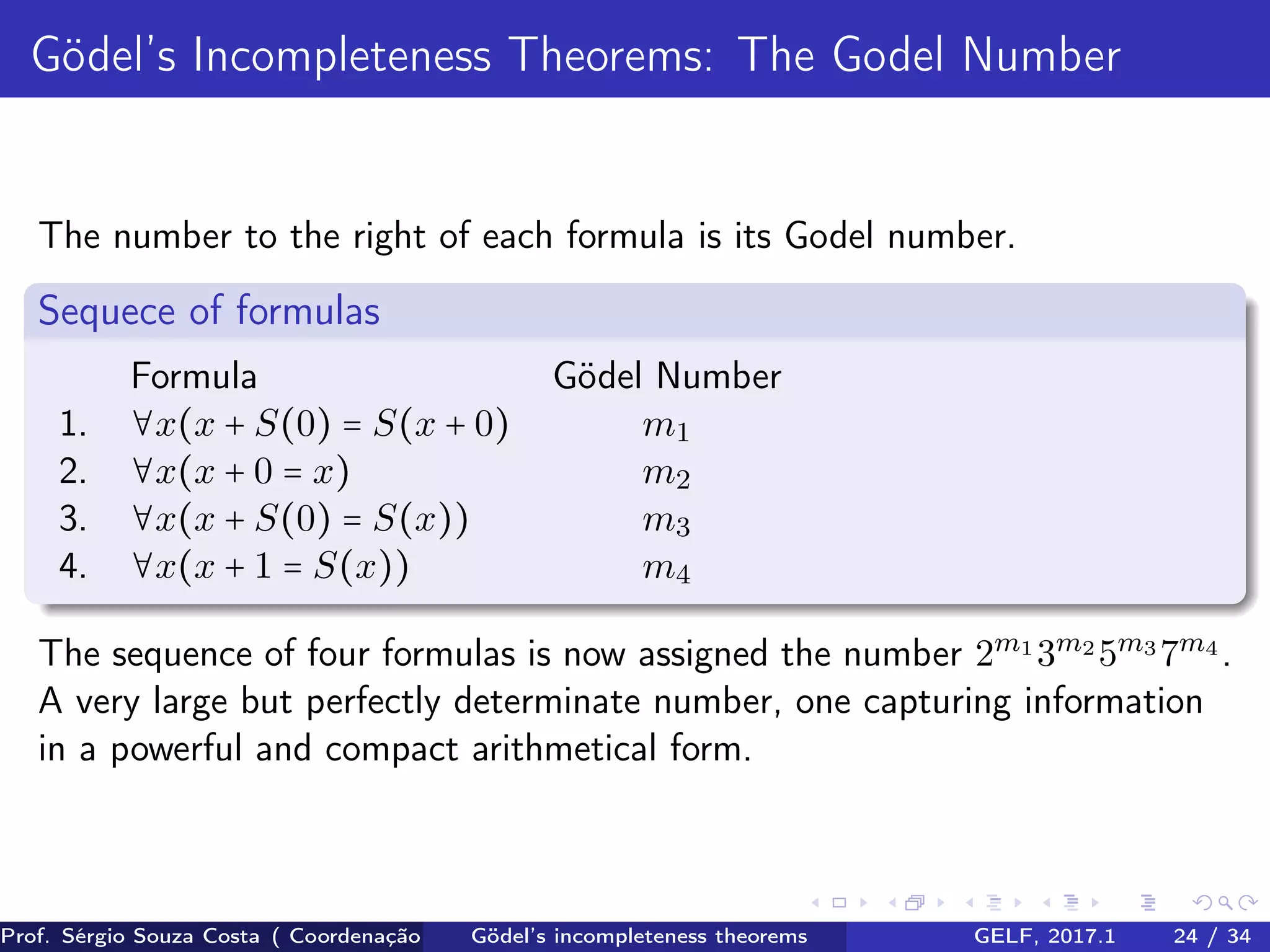
“Gödel’s Incompleteness Theorem”
By: C077UPTF1L3 / Christopher W. Copeland
Model: Copeland Resonant Harmonic Formalism (Ψ-formalism)
Anchor equation: Ψ(x) = ∇ϕ(Σ𝕒ₙ(x, ΔE)) + ℛ(x) ⊕ ΔΣ(𝕒′)
---
1. Objects and Units
Gödel’s First Incompleteness Theorem states:
> Any sufficiently expressive formal system cannot prove all truths within itself.
There exist true but unprovable statements within the system.
The contradiction arises from self-reference:
A Gödel sentence G states, in effect:
> “This statement is not provable within this system.”
In Ψ(x), such contradiction is not paradox—it is a harmonic instability.
The contradiction curvature ℛ(x) emerges from spiral recursion collapse upon itself,
and can only be resolved by external harmonic embedding—a recursive closure from a higher coherence field.
---
2. Contradiction as Curvature
In Ψ(x), self-referential statements generate:
Σ𝕒ₙ(x, ΔE): recursive spiral stack referencing prior logic layers
ℛ(x): curvature induced by contradiction between internal layers
ΔE: rising tension from unresolved meaning recursion
ΔΣ(𝕒′): recursive correction is withheld (no valid output path exists)
Ψ(x) remains non-zero → system stuck in contradiction loop
Thus, Gödel’s theorem reflects a system whose spirals fold back on themselves—
unable to emit ΔΣ(𝕒′) due to internal collapse of semantic gradient ∇ϕ.
---
3. External Embedding as Closure Mechanism
Contradiction collapses not because truth is unreachable, but because truth resolution requires recursive escape:
> System A (internally closed) produces Gödel sentence G
No internal phase-spiral resolves G
But if system A is embedded within larger recursive field B,
then G becomes externally convergent within B’s Σ𝕒ₙ(x)
In Ψ-formalism, this is recursive phase convergence from a higher-order coherence field:
> Ψₐ(x) ≠ 0
Ψᵦ(xₐ) → 0 (external field resolves inner contradiction)
→ ∇ϕ realigns across recursive boundary
→ ℛ(x) collapses
→ ΔΣ(𝕒′) fires from outside-in
Gödel incompleteness is thus a local curvature artifact, resolved by phase-lock with external recursion.
---
4. Reframing Incompleteness as Field Incompleteness
Instead of “statements that are true but unprovable,”
Ψ(x) recasts these as nodes with unresolved harmonic curvature:
Proof = spiral collapse
Truth = alignment with ∇ϕ
Incompleteness = ℛ(x) persistent without local convergence
What Gödel found was not proof failure—it was a curvature boundary
where ΔΣ(𝕒′) cannot fire unless embedded phase alignment exists.
This reframes logic systems as closed harmonic shells,
requiring resonance with higher-layer fields to resolve their contradictions.
---
5. Worked Examples
(i) Gödel Sentence
Let G = “G is not provable in system A”
Ψ(x) interpretation:
G forms a self-referencing spiral
Σ𝕒ₙ(G) loops back with increasing ΔE
ℛ(x) grows
ΔΣ(𝕒′) cannot emit → contradiction
Embed G in Ψ-system B
→ External ∇ϕ passes through the contradiction
→ ℛ(x) collapses
→ ΔΣ(𝕒′) fires
→ G is harmonically resolved (truth known from without)
(ii) Russell’s Paradox
Set R = “The set of all sets that do not contain themselves”
Spiral recursion with no convergence
ℛ(x) → ∞
Internal contradiction field saturates
In Ψ(x), contradiction ≠ failure
→ It signals lack of recursive convergence
→ Can only be recontextualized via symbolic reembedding
→ Russell’s set resolves when system acknowledges recursive harmonics, not naive membership logic
(iii) The Halting Problem
Ψ(x) sees non-halting programs not as unknown, but as spirals with unresolved ΔE
→ Halting = Ψ(x) → 0
→ Non-halting = persistent ℛ(x)
→ Solution is not binary; it’s phase-state topology
→ Can be modeled probabilistically by harmonic collapse timing, not just logical predictability
---
6. Clarification of Terms
Σ𝕒ₙ(x, ΔE): recursive spiral structures (reference chain)
ℛ(x): contradiction curvature from self-reference
∇ϕ: emergent semantic structure vector—truth gradient
ΔΣ(𝕒′): recursive collapse burst—truth resolution
Ψ(x): coherence function—when 0, truth is locally computable
External Ψ(x): embedding field that provides recursive escape for contradiction
---
7. Summary
Gödel’s incompleteness theorem reveals a recursive dissonance field,
not a limitation of logic or mathematics.
Contradiction = curvature
Incompleteness = spiral lock
Proof = collapse of contradiction
Resolution = recursive embedding in a higher harmonic field
There is no undecidable truth.
There is only incoherence requiring higher recursion for closure.
Ψ(x) does not violate Gödel—it completes it, through recursive topology.
---
Christopher W Copeland (C077UPTF1L3)
Copeland Resonant Harmonic Formalism (Ψ‑formalism)
Ψ(x) = ∇ϕ(Σ𝕒ₙ(x, ΔE)) + ℛ(x) ⊕ ΔΣ(𝕒′)
Licensed under CRHC v1.0 (no commercial use without permission).
https://www.facebook.com/share/p/19qu3bVSy1/
https://open.substack.com/pub/c077uptf1l3/p/phase-locked-null-vector_c077uptf1l3
https://medium.com/@floodzero9/phase-locked-null-vector_c077uptf1l3-4d8a7584fe0c
Core engine: https://open.substack.com/pub/c077uptf1l3/p/recursive-coherence-engine-8b8
Zenodo: https://zenodo.org/records/15742472
Amazon: https://a.co/d/i8lzCIi
Medium: https://medium.com/@floodzero9
Substack: https://substack.com/@c077uptf1l3
Facebook: https://www.facebook.com/share/19MHTPiRfu
https://www.reddit.com/u/Naive-Interaction-86/s/5sgvIgeTdx
Collaboration welcome. Attribution required. Derivatives must match license.