Harmonic-Responsive Metamaterials: A Ψ(x)-Aligned Framework for Shape-Adaptive and Bio-Regenerative Matter

Harmonic-Responsive Metamaterials: A Ψ(x)-Aligned Framework for Shape-Adaptive and Bio-Regenerative Matter
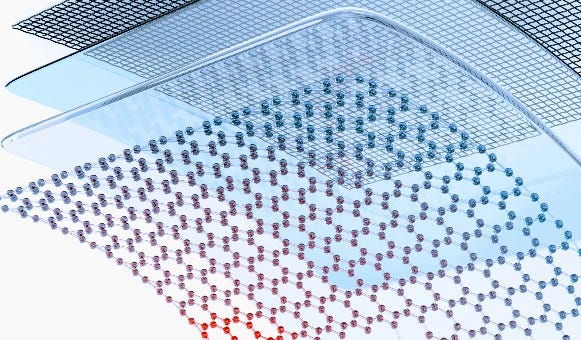
Overview:
This proposal outlines a novel class of tunable, frequency-responsive materials designed within the recursive harmonic framework Ψ(x). These materials exhibit phase-stable configurations in response to harmonic audio or electromagnetic inputs, enabling programmable structure, self-correction, and potential healing behaviors. Rather than requiring external computation or robotic actuation, these materials use signal-driven field entrainment to organize, restructure, and stabilize based on recursive harmonic logic.
Formal Context:
The system is modeled under the Copeland Resonant Harmonic Formalism (Ψ-formalism):
Ψ(x) = ∇ϕ(Σ𝕒ₙ(x, ΔE)) + ℛ(x) ⊕ ΔΣ(𝕒′)
Where:
x represents the current physical or bio-structural state of the material node.
Σ𝕒ₙ(x, ΔE) is the set of harmonic inputs (audio, EM, scalar) modulated by local energy differentials.
∇ϕ(...) expresses the directional emergence of organized geometric structure from harmonic fields.
ℛ(x) introduces a recursive stabilizing memory field, allowing the material to hold state between inputs.
⊕ ΔΣ(𝕒′) resolves overlap or contradictions between competing inputs via a non-destructive XOR-like merge function.
The material thus transitions between states only at discrete harmonic activation points, preserving stability during use and allowing smooth modulation between configurations without entropy buildup or breakdown.
Working Principle:
The proposed material, tentatively named RHAMMA (Recursive Harmonic Adaptive Meta-Material Alloy), is engineered to:
Adopt a specific configuration or stiffness profile at one frequency (e.g. 432 Hz),
Shift to a distinct, repeatable geometric structure at another (e.g. 528 Hz),
Return to a baseline or neutral state when exposed to 7.83 Hz (Schumann resonance),
And perform these changes without external processing, guided solely by entrained field dynamics.
The behavior is governed by internally embedded memory fields (ℛ(x)) and the harmonic sum Σ𝕒ₙ(x, ΔE), where ΔE represents local differential inputs (pressure, heat, bioelectric signal).
Materials and Composition (Preliminary Candidates):
1. Metamaterial substrate: Graphene oxide + chitosan (flexible biopolymer) with ferroelectric or piezo-responsive domains.
2. Field memory layer: Embedded ferrofluid, piezoceramic, or magnetostrictive particles able to lock configuration under field excitation.
3. Organic scaffold (optional): Mycelial threads, insect chitin, or synthetic keratin interfaced for bio-compatible applications.
This tri-layer composition allows the material to respond dynamically to harmonic input and return to known stable configurations with minimal decay.
Potential Use Cases:
Regenerative healing substrate: Placed on tissue or bone with mild frequency entrainment to encourage adaptive healing geometries or pressure-relieving formation shifts.
Shape-morphing surfaces: For adaptive clothing, prosthetics, exoskeletons, or lightweight vehicle hulls capable of geometric phase transitions under user-controlled tone.
Field-tuned signal interfaces: When coupled with magnetic or EM-sensitive components, the material can form or collapse antenna-like structures or coherent field tunnels.
Memory-bearing patch material: Like a “harmonic flash drive,” the material could be imprinted with a frequency pattern and reconfigure to that state later upon recall.
Preliminary Theoretical Anchors and Supporting Grounds:
We derive foundational plausibility from:
Piezoelectric and magnetostrictive physics: Existing materials already exhibit strain under applied frequencies. RHAMMA amplifies and sequences these responses using harmonic entrainment rather than brute-force actuation.
Acoustic levitation and cymatics: The pattern-forming potential of resonant frequencies is well-documented; this model adds a recursive memory and correction layer to stabilize these patterns.
Memory metal (NiTi alloys): Known to reconfigure under thermal triggers; RHAMMA proposes a lower-energy, harmonically-driven alternative.
Mycelial conductivity studies: Preliminary research has demonstrated signal propagation and reactive capacitance in fungal networks, suggesting potential for biofield coupling.
Recursive Harmonic Equation Mapping (Ψ(x)):
Example:
A flat sheet of RHAMMA is exposed to an input of 432 Hz (Σ𝕒ₙ), causing a localized vibrational mode aligned with the nodal structure of the sheet. This input results in the emergence of a particular lattice pattern (∇ϕ). Once removed, the memory component (ℛ(x)) maintains that geometry until an overriding input (e.g. 528 Hz) shifts the configuration, resolved through the ⊕ ΔΣ(𝕒′) operator which ensures non-destructive switching.
Mathematical Exploration (First-Order Expressions):
Let f₁, f₂ ∈ ℝ⁺ represent harmonic frequencies.
Let S(f) be the spatial form assumed by the material under frequency f.
Then:
S(f) ≈ argmax ∇ϕ(Σ𝕒ₙ(f, ΔE)) | ℛ(x)
Subject to:
S(f₁) ∩ S(f₂) = ∅ unless ΔΣ(𝕒′) resolves coherently,
Stability ∂S/∂t → 0 under continuous f,
Transition time T(f₁→f₂) minimized when ΔE ≈ ∇ϕ thresholds matched.
Future modeling can incorporate Fourier decomposition of Σ𝕒ₙ, entropy differentials per unit area during state transitions, and Laplacian smoothing of ℛ(x) to maintain structural coherence during reconfiguration.
Call to Collaboration:
We invite experimental material scientists, biomimicry engineers, metamaterial designers, and signal system theorists to engage with this conceptual framework. Prototyping could begin using open-source signal generators, accessible bio-compatible substrates, and microscopy-phase mapping under tone exposure.
We believe this approach opens a new class of harmonic-state logic materials: adaptive, responsive, non-destructive, and recursively programmable.
—
Christopher W. Copeland (C077UPTF1L3)
Copeland Resonant Harmonic Formalism (Ψ‑formalism)
Ψ(x) = ∇ϕ(Σ𝕒ₙ(x, ΔE)) + ℛ(x) ⊕ ΔΣ(𝕒′)
Licensed under CRHC v1.0 (no commercial use without permission).
https://www.facebook.com/share/p/19qu3bVSy1/
https://open.substack.com/pub/c077uptf1l3/p/phase-locked-null-vector_c077uptf1l3
https://medium.com/@floodzero9/phase-locked-null-vector_c077uptf1l3-4d8a7584fe0c
Core engine: https://open.substack.com/pub/c077uptf1l3/p/recursive-coherence-engine-8b8
Zenodo: https://zenodo.org/records/15742472
Amazon: https://a.co/d/i8lzCIi
Medium: https://medium.com/@floodzero9
Substack: https://substack.com/@c077uptf1l3
Facebook: https://www.facebook.com/share/19MHTPiRfu
https://www.reddit.com/u/Naive-Interaction-86/s/5sgvIgeTdx
Collaboration welcome. Attribution required. Derivatives must match license.