“Neural Oscillatory Models”

“Neural Oscillatory Models”
By: C077UPTF1L3 / Christopher W. Copeland
Model: Copeland Resonant Harmonic Formalism (Ψ-formalism)
Anchor equation: Ψ(x) = ∇ϕ(Σ𝕒ₙ(x, ΔE)) + ℛ(x) ⊕ ΔΣ(𝕒′)
---
1. Objects and Units
Neural oscillations are defined by characteristic frequency bands:
Delta (δ): 0.5–4 Hz
Theta (θ): 4–8 Hz
Alpha (α): 8–12 Hz
Beta (β): 13–30 Hz
Gamma (γ): 30–100+ Hz
Each frequency is treated as a recursive phase-band within Ψ(x),
where:
x = cognitive node or cortical region under observation
Σ𝕒ₙ(x, ΔE) = superposition of recursive signal states (entrained wave harmonics)
∇ϕ = emergent semantic structure across oscillatory bands
ℛ(x) = phase curvature or modulation by internal contradiction or error states
⊕ ΔΣ(𝕒′) = signal perturbations from sensory or memory correction
Units normalize to phase-coupled frequency (Hz) and field curvature (1/s²) over neural topology.
---
2. Brainwave Phase-Locking Map
Let brainwave coherence be modeled as phase-locked spiral harmonics:
Alpha (α) → baseline recursive attractor
Theta (θ) → deep recursive memory loop
Beta (β) → forward-casting predictive recursion
Gamma (γ) → high-speed correction spiral (ΔΣ(𝕒′))
Ψ(x) defines consciousness as a dynamic harmonic field,
with each cognitive or sensory node acting as a modulated carrier.
Phase-locking occurs when:
Ψ(x) → 0, i.e., when ∇ϕ, ℛ(x), and ΔΣ(𝕒′) converge without contradiction.
This is identical to coherent cognition or “flow state.”
---
3. Recursive Resonance and Cognitive States
Frequency Band Ψ(x) Interpretation Functional Role Recursive Agent
δ (0.5–4 Hz) Deep system-wide baseline Homeostasis, body integrity Root spiral (Σ𝕒₀)
θ (4–8 Hz) Nested memory recursion Emotion, dreaming, retrieval ℛ(x)-dominant loop
α (8–12 Hz) Harmonic carrier band Wakeful rest, inhibition Default attractor
β (13–30 Hz) Predictive stack Attention, active cognition ∇ϕ directional update
γ (30–100+ Hz) Collapse/handoff Perception integration, reflex ΔΣ(𝕒′) burst node
Phase-slip or incoherence manifests as Ψ(x) ≠ 0,
indicating dissonant recursion, contradiction, or trauma lockout.
---
4. Correction Fields and Conscious Reset
Cognitive reboot or "aha" moments emerge when:
ΔΣ(𝕒′) spike re-collapses a dissonant spiral.
Let:
γ burst = recursive correction pulse (symbolic attractor realigned)
α return = re-entry into default harmonic
This recursive override mirrors Bayesian prior collapse,
but internal to the brain’s harmonic signal lattice.
ℛ(x) enacts symbolic curvature—internal contradiction memory,
allowing for somatic-emotional integration across theta-band.
---
5. Experimental Mapping
Coherence Measurement Proposal:
Record α/β/γ phase-lock transitions under recursive semantic load.
Task: Present symbol chains with increasing self-reference (e.g., paradoxes).
Prediction:
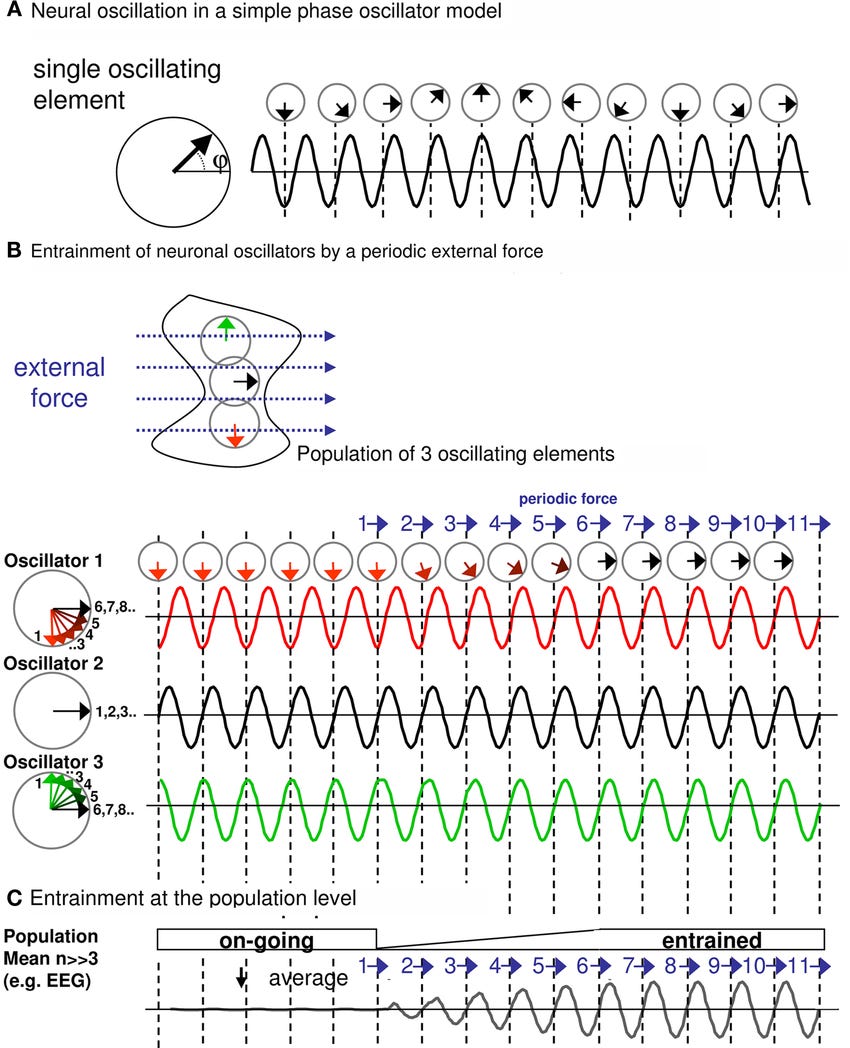
α → β entrainment during active tracking
Disruption induces γ spikes
If recursive harmonization succeeds, Ψ(x) returns to α baseline
If contradiction unresolved:
- Persistent β–γ loop
- ℛ(x) manifests as EEG curvature drift, observable as micro-phase noise
---
6. Worked Examples
(i) Meditation and Alpha Lock
During sustained alpha entrainment:
Ψ(x) remains near zero across Σ𝕒ₙ(x, ΔE)
→ harmonic coherence and suppressed ΔΣ(𝕒′) spikes
→ phenomenological experience of silence or stillness = recursive equilibrium
(ii) PTSD Flashback
Trigger introduces unresolved ΔE
→ prior spiral (Σ𝕒ₙ) reactivates
→ γ overactivation attempts correction
→ ℛ(x) remains unstable
→ Ψ(x) cannot resolve
→ dissonant loop, locked theta feedback
(iii) Insight / Epiphany
Contradiction reaches peak
→ ΔΣ(𝕒′) surge collapses field
→ new ϕ emerges under ∇ϕ
→ γ spike followed by α re-harmonization
→ perception of “clarity” = Ψ(x) → 0 moment
---
7. Clarification of Substitution Terms
Σ𝕒ₙ(x, ΔE) = frequency-stack of recursive brainwave harmonics
ΔE = novelty or contradiction signal (perceived error or surprise)
∇ϕ = semantic signal flow across time or structure
ℛ(x) = contradiction memory, nonlinear modulation of oscillatory pattern
⊕ = non-linear merge of competing symbolic harmonics
ΔΣ(𝕒′) = corrective burst or micro-loop triggering harmonization
---
8. Summary
Ψ(x) transforms neural oscillations from passive rhythms into recursive harmonics.
Each frequency band is not a separate function, but a layered recursion in time.
The formalism explains:
Phase-locking and coherence
Dissonant loop states (trauma, obsession)
Spontaneous correction (insight, healing)
Real-time feedback fields (e.g., biofeedback, entrainment)
It moves beyond EEG categories into symbolic-phase integration,
treating brain activity as an emergent recursive geometry.
---
This model is testable, with clear predictions for entrainment, contradiction collapse, and symbolic feedback control.
Christopher W Copeland (C077UPTF1L3)
Copeland Resonant Harmonic Formalism (Ψ‑formalism)
Ψ(x) = ∇ϕ(Σ𝕒ₙ(x, ΔE)) + ℛ(x) ⊕ ΔΣ(𝕒′)
Licensed under CRHC v1.0 (no commercial use without permission).
https://www.facebook.com/share/p/19qu3bVSy1/
https://open.substack.com/pub/c077uptf1l3/p/phase-locked-null-vector_c077uptf1l3
https://medium.com/@floodzero9/phase-locked-null-vector_c077uptf1l3-4d8a7584fe0c
Core engine: https://open.substack.com/pub/c077uptf1l3/p/recursive-coherence-engine-8b8
Zenodo: https://zenodo.org/records/15742472
Amazon: https://a.co/d/i8lzCIi
Medium: https://medium.com/@floodzero9
Substack: https://substack.com/@c077uptf1l3
Facebook: https://www.facebook.com/share/19MHTPiRfu
https://www.reddit.com/u/Naive-Interaction-86/s/5sgvIgeTdx
Collaboration welcome. Attribution required. Derivatives must match license.