Personal Reflection on Sink Replacement, Persistent Injuries, and Workplace Response

Personal Reflection on Sink Replacement, Persistent Injuries, and Workplace Response
I want to share some thoughts gently and clearly—not in blame, but in the hope of being understood.
Since the arrival of our current sink a little under a year ago, I’ve been raising concerns about its construction and progressive deterioration almost from the start. Within weeks, I began noticing splits forming along its seams, and I communicated those concerns clearly—particularly about the sharpness developing at the edges. At the time, I wasn’t being overly cautious; I was trying to prevent what I now know was inevitable.
This newer sink replaced an older one that had been in place for over a decade. The previous model was aging but still serviceable; its only major issue was corrosion at the base. When asked to gather measurements and specifications for the replacement, I gave thorough recommendations for a solid, load-bearing, continuous-basin design with welded dividers—something durable and suited to our kind of work. Instead, a cheaper alternative was chosen to save nearly $1,000. It looked similar but was fundamentally different in both build and purpose. What we received is a modular, thin-walled unit meant for restaurant dish racks and lightweight glassware—not for the heavy sheet pans, pots, and industrial cookware that define our operation.
As a result, this new sink has become a serious hazard. Its construction leaves multiple dangerously sharp, exposed seams—not just one. Three of its four sides—front, left, and back—each feature two razor-like edges:
1. One at the top, where the basin joins the countertop or support frame.
2. One underneath, where the basin’s side panel terminates.
That makes a total of six linear, blade-like seams, each roughly 24 to 30 inches long. Only the right edge of the sink is free from these hazards. So every time I reach in, lean forward, or pull my arms up from the water—unless I stay entirely to the right—I risk slicing my wrist, forearm, or elbow on one of these invisible edges.
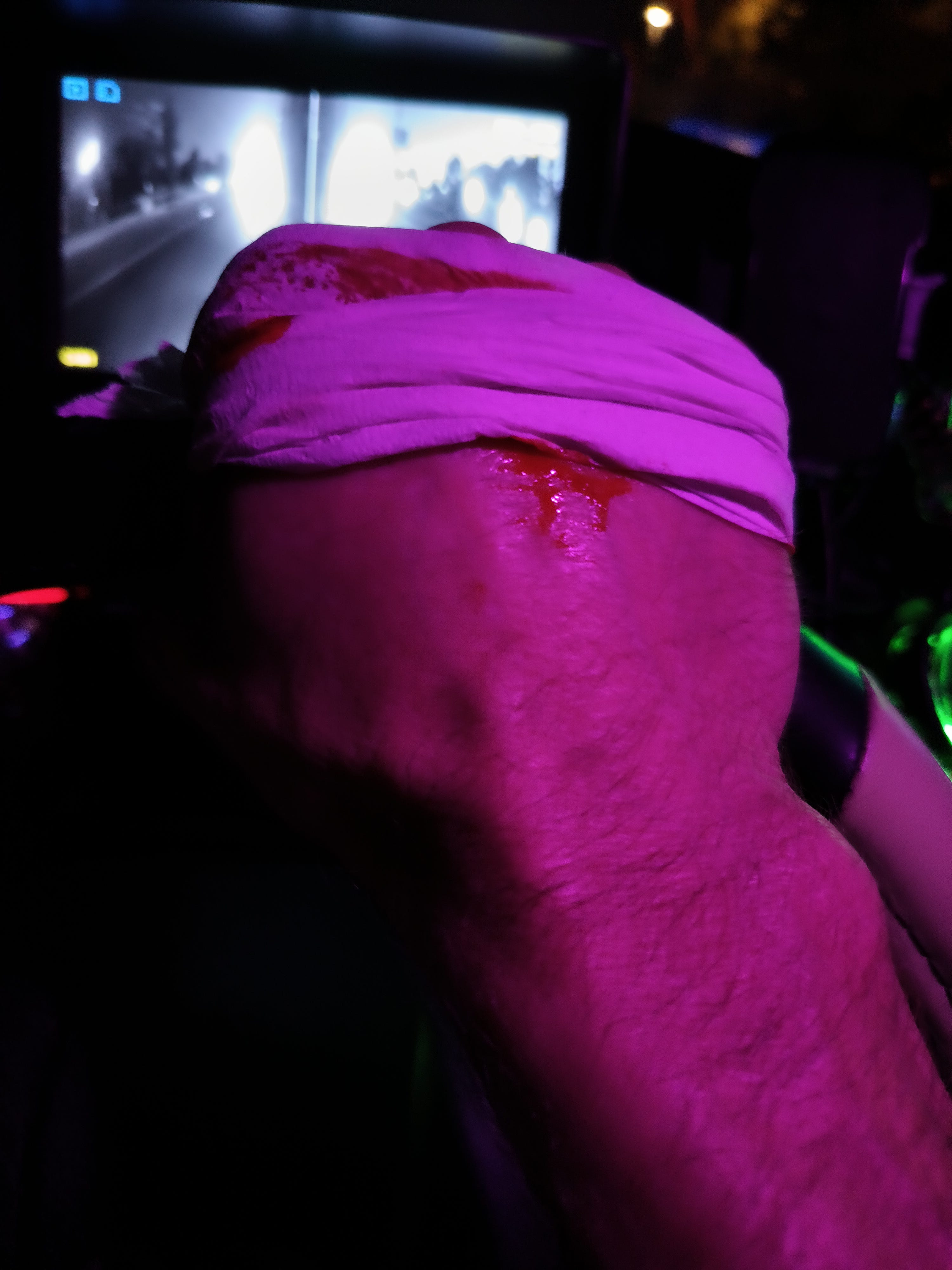
Since the sink was installed, I’ve been cut numerous times—sometimes small nicks, sometimes deeper wounds. These injuries happen during ordinary, unavoidable motions of dishwashing. And the nature of my work compounds their severity: my arms are constantly submerged in a caustic mix of hot, chlorinated detergent, grease, and food debris. Any wound that opens cannot scab; it is repeatedly soaked, stripped of oils, and exposed to contamination. Many nights, I’ve come home and had to wash food particles out of open cuts that had barely started to close.
At one point, I even capped the sink using cutting boards and plastic lids to protect myself. It worked. But that workaround was removed—not for safety reasons, but to restore access to the garbage disposal. The disposal wasn’t broken; the decision appears to have been about convenience. To achieve that, the sink was propped with a heavy-duty truck jack and clamps, and a plumber reconnected the disposal. My temporary safety measure was sacrificed so the disposal could function.
I know we have a new sink scheduled for installation on Monday, and I do appreciate that. I also recognize the cost involved and that it’s frustrating for ownership to replace something purchased less than a year ago. But I want to say this clearly: the injuries I’ve endured since this sink was installed have been consistent, documented through direct communication, and entirely preventable had the early warnings been acted on.
I’ve lost work hours and pay due to these injuries. I’ve been questioned for taking long breaks when tending to wounds. I’ve returned to work with bandaged hands wrapped in gauze and Saran wrap, bleeding through, because there is no backup plan when I’m hurt. And yet, I’ve never filed a workers’ compensation claim, never asked for medical reimbursement, and have either used my own insurance or treated myself privately.
What stings most is how this situation gets reframed. When I mention an injury, it’s often met with eye-rolls, sighs, or gossip about my reliability. Occasionally, someone asks if I need to go to the ER—but more often, I’m met with subtle scolding or veiled threats about being replaced: “We can’t not have a dishwasher,” or “We’ll need someone reliable.” I’ve overheard my name used as shorthand for being a “problem.” The message is clear: my injury is an inconvenience to others.
And yet, my default mode is self-examination. Whenever something goes wrong, my instinct is to ask: Am I at fault? Could I have done this differently? I turn over every variable, looking for how I might have contributed. But in this case, it’s not carelessness. It’s not speed. It’s the design itself—and the culture that treats injury as an annoyance rather than a warning.
The manager has even suggested that I’m injured because I rush, referencing video footage that shows me leaving the sink quickly. What he doesn’t see is the pain that caused that urgency, or the reopened wound that I was trying to clean before it got worse. He sees motion; I experience injury. There’s a vast difference between those two realities.
I also can’t ignore a larger pattern that this situation represents. Time and again, I’ve been asked for my input, given it thoughtfully, and watched as the decision went another way—usually to save time or money. And then, when the consequences surface, I’m the one who absorbs them. This time, the cost is finally visible in dollars, but for years, it’s been visible only in my hands.
I don’t say any of this in anger. I’m just tired—tired of repeating the same lesson, tired of feeling unseen, tired of being positioned as the problem because I’m the one willing to describe the problem. The reality is simple: I’m not the liability. The hazard is. The silence is.
What I want is for decisions moving forward to reflect the full, lived reality of the work being done. I want safety concerns to be taken seriously before someone gets hurt again. Because no amount of money spent on replacements or repairs will matter if we don’t also repair the pattern that led here.
This isn’t about dramatizing discomfort. It’s about recognizing a physical reality that has been ignored for too long—and ensuring the next solution isn’t just a new sink, but a new way of listening.
Christopher W Copeland (C077UPTF1L3)
Copeland Resonant Harmonic Formalism (Ψ‑formalism)
Ψ(x) = ∇ϕ(Σ𝕒ₙ(x, ΔE)) + ℛ(x) ⊕ ΔΣ(𝕒′)
Licensed under CRHC v1.0 (no commercial use without permission).
https://www.facebook.com/share/p/19qu3bVSy1/
https://open.substack.com/pub/c077uptf1l3/p/phase-locked-null-vector_c077uptf1l3
https://medium.com/@floodzero9/phase-locked-null-vector_c077uptf1l3-4d8a7584fe0c
Core engine: https://open.substack.com/pub/c077uptf1l3/p/recursive-coherence-engine-8b8
Zenodo: https://zenodo.org/records/15742472
Amazon: https://a.co/d/i8lzCIi
Medium: https://medium.com/@floodzero9
Substack: https://substack.com/@c077uptf1l3
Facebook: https://www.facebook.com/share/19MHTPiRfu
https://www.reddit.com/u/Naive-Interaction-86/s/5sgvIgeTdx
Collaboration welcome. Attribution required. Derivatives must match license.
Reminds me of when I worked at a restaurant. We cooked baked potatoes in large batches on trays in a convection type oven. The trays slid in and out. In was not a problem. Out though, the safety gloves we had for handling the trays came up to almost the elbow. BUT, the trays would slide (slide is a key word) all the way down slightly past the gloves. I had burns from those trays quite a few times. Nothing horrible, you learn quick to be as cautious as you can be. But, the gloves simply were not long enough. I never said anything about it though.