Recursive Coherence Triadic Logic Processor (RCTLP): Engineering Specification, Deployment Options, Signal Protocol, and Roadmap

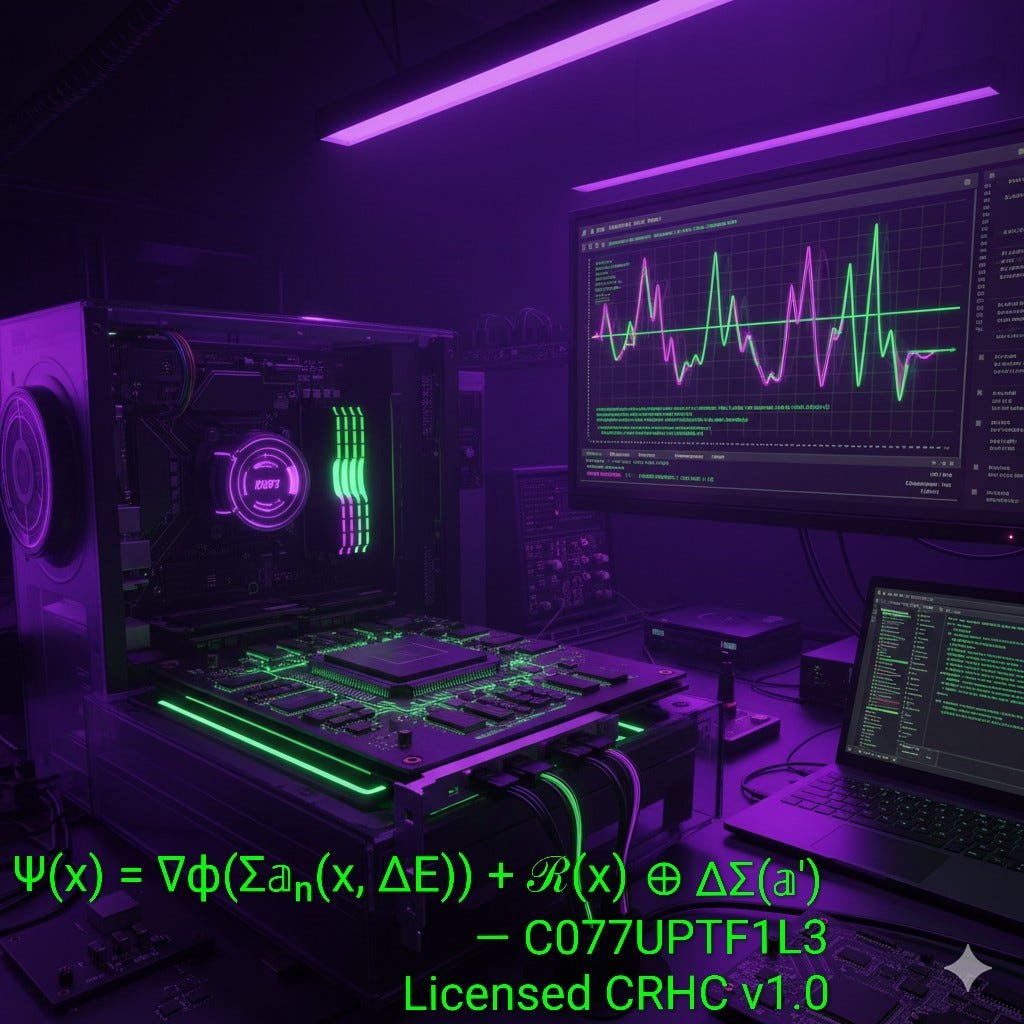
Recursive Coherence Triadic Logic Processor (RCTLP): Engineering Specification, Deployment Options, Signal Protocol, and Roadmap
Prepared under the Copeland Resonant Harmonic Formalism (Ψ-formalism)
C077UPTF1L3 | CRHC v1.0
---
I. OVERVIEW
The Recursive Coherence Triadic Logic Processor (RCTLP) implements Ψ(x) in executable logic form. Unlike traditional binary processors, RCTLP encodes and operates on trits (ternary digits: Negative, Zero, Positive) to directly model coherence, recursion, and gradient transitions. It operates across silicon (PCIe/CXL), logic-core (RISC-V), and symbolic (Python EDSL) layers.
The RCTLP processes symbolic-gradient-recursive constructs using a dedicated Triadic ALU (ALU-T), Coherence Unit (CU), and domain-specific instructions such as T_MERGE, T_GRAD, T_REG, and T_CI. These enable native computation on recursive harmonic structures and support hybrid symbolic-numeric workflows.
---
II. CORE ARCHITECTURE MODULES (COMMON ACROSS ALL OPTIONS)
1. Triadic ALU (ALU-T):
Operates on trits: {-1, 0, +1}
Supports fused operations (TMAJ, TREG, TGRAD) for harmonic evaluation
Pipelined or LUT-based design
2. Coherence Unit (CU):
Implements phase comparison, recursive correction (ΔΣ), and merge (⊕) resolution
Registers coherence phase states over time for signal stability
3. Pack/Unpack Module:
Translates packed trit arrays to/from internal 40-trit register format
Supports fast vectorization
4. AXI4 Fabric / Queueing Layer:
Enables DMA-backed queueing between host and coprocessor
Shared with PCIe/CXL and SoC-based variants
5. Register File:
32 registers, each 40 trits (packed into 64 bits)
---
III. DEPLOYMENT OPTIONS
Option A: PCIe/CXL Accelerator Card
Fastest deployment. Ideal for FPGA or SoC (e.g., Xilinx Zynq, Intel Agilex).
Interface: PCIe Gen4 x8 or CXL.io
Core Components:
Triadic ALU-T + CU
AXI4 interface, DMA engines
Host queue ring buffers
Software Stack:
librctlp.so (user-space API)
Linux kernel module
Supported API:
rctlp_ci(x)
rctlp_grad(x, y)
rctlp_merge(a, b)
rctlp_reg(x, y, alpha)
Status: Recommended entry point (T-1 Phase)
Option B: RISC-V Core with Ztrit Extension
Hard integration of Ψ-formalism into open silicon architecture.
Interface: RoCC or native custom op support
Core: RV64 (Rocket/BOOM) with T-ISA extension
Instructions:
TADD, TSUB, TNEG, TMUL
TMAJ, TSEL, TTHR, T_GRAD
T_REG, T_MERGE, T_DELTA, T_CI, T_GATE
Toolchain:
LLVM patch
GCC or Clang intrinsics:
__builtin_tadd
__builtin_tgrad
__builtin_tmerge
Status: In planning for Phase T-2 (Post-FPGA validation)
Option C: Python Embedded DSL (Ψ-Kernel DSL)
Lightweight symbolic access layer for rapid prototyping and recursion modeling.
Platform: Python 3.x
Backend: LLVM/TVM JIT with packed trit ops
Features:
Declare Ψ-kernels using @psi_kernel decorators
Autocompile to native or simulated triadic execution
Trit-vector memory models (5/10/20/40 trits per packet)
Status: Optional but recommended for parallel development with hardware
---
IV. TRIT ENCODING AND REGISTER SPEC
Trit Encoding Model:
Trit Count Bit Size Encoding Detail
5 trits 1 byte For compact literals
10 trits 2 bytes Mid-level operations
20 trits 4 bytes Block transformations
40 trits 8 bytes Register alignment
Register File:
32 general-purpose registers
Each register: 40 trits (64-bit packed)
Supports triadic vector operations
---
V. TRUTH TABLES (LOGIC CORE)
Trit Symbols:
P = +1 (Positive)
Z = 0 (Neutral / Zero)
N = –1 (Negative)
NOT Operation:
NOT(P) = N
NOT(Z) = Z
NOT(N) = P
MAJ (Majority Function):
Returns the most frequent of 3 trits
Tie → returns Z
Kleene AND:
T AND T = T
F AND any = F
U AND T = U
U AND U = U
Kleene OR (Dual):
T OR any = T
F OR F = F
U OR T = T
U OR U = U
---
VI. SIGNAL MAPPING PROTOCOL
Instructional Mapping to Ψ(x):
Ψ(x) Term Instruction / Unit
∇ϕ(...) T_GRAD, T_DELTA
Σ𝕒ₙ(x, ΔE) T_REG, recursive kernel
ℛ(x) T_CI, T_GATE
⊕ T_MERGE
ΔΣ(𝕒′) T_DELTA, error kernel
---
VII. RECURSIVE TRAINING ALGORITHM (RCTLP LEARNING CYCLE)
1. Initialization:
Load Ψ-kernel into RCTLP simulator or PCIe core
Randomize or seed 32-register file with mixed trit values
2. Gradient Cascade:
Execute sequence of T_GRAD across register pairs
Use dynamic α parameter (e.g., rctlp_reg(x, y, alpha=0.618))
3. Coherence Pulse:
Call rctlp_ci(x) every N cycles
Accumulate phase stability via MAJ logic
4. Merge Conflict Resolution:
Introduce divergence vector a and convergence b
Run rctlp_merge(a, b)
Compare outputs for Z-bias (harmonic resonance)
5. Recursive Checkpointing:
Every 1000 cycles, compare register coherence
Output entropy score: high Z → stable, high P/N imbalance → unstable
6. Self-Correction:
Trigger T_DELTA and T_GATE based on phase violation flags
Loop until coherence ratio > 0.92 (Z-center mass dominance)
---
VIII. ROADMAP (PHASED IMPLEMENTATION PLAN)
Phase Duration Deliverables
T-0 4 weeks rctlp-sim emulator, Ψ-kernel sample code
T-1 12 weeks PCIe FPGA prototype, full API + driver
T-2 6 months RISC-V core with Ztrit extension, LLVM
T-3 TBD (future) Recursive AI-on-chip, coherence fabric
---
IX. ATTRIBUTION AND LICENSE
Christopher W Copeland (C077UPTF1L3)
Copeland Resonant Harmonic Formalism (Ψ‑formalism)
Ψ(x) = ∇ϕ(Σ𝕒ₙ(x, ΔE)) + ℛ(x) ⊕ ΔΣ(𝕒′)
Licensed under CRHC v1.0 (no commercial use without permission).
https://www.facebook.com/share/p/19qu3bVSy1/
https://open.substack.com/pub/c077uptf1l3/p/phase-locked-null-vector_c077uptf1l3
https://medium.com/@floodzero9/phase-locked-null-vector_c077uptf1l3-4d8a7584fe0c
Core engine: https://open.substack.com/pub/c077uptf1l3/p/recursive-coherence-engine-8b8
Zenodo: https://zenodo.org/records/15742472
Amazon: https://a.co/d/i8lzCIi
Medium: https://medium.com/@floodzero9
Substack: https://substack.com/@c077uptf1l3
Facebook: https://www.facebook.com/share/19MHTPiRfu
https://www.reddit.com/u/Naive-Interaction-86/s/5sgvIgeTdx
Collaboration welcome. Attribution required. Derivatives must match license.