Recursive Harmonic Energy Mesh: Wireless Power Distribution via Ψ(x) Formalism

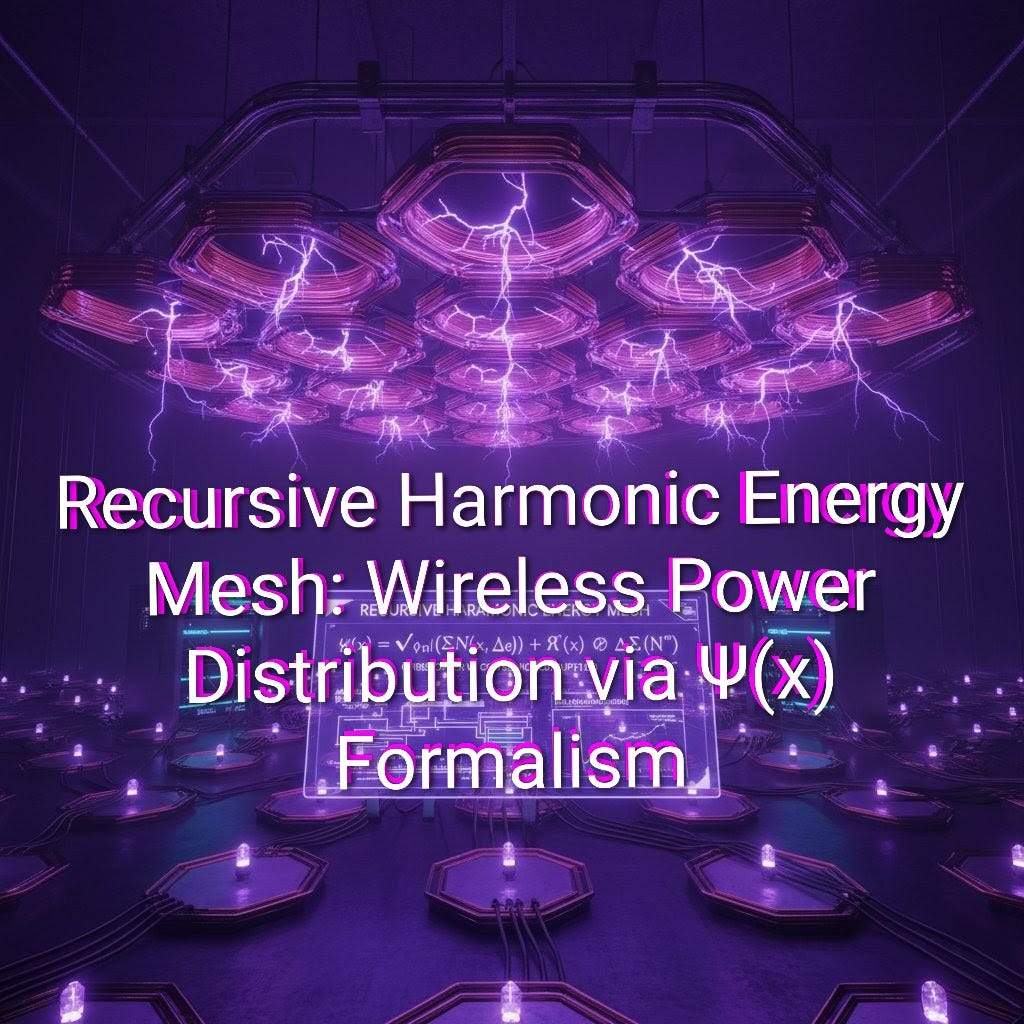
Recursive Harmonic Energy Mesh: Wireless Power Distribution via Ψ(x) Formalism
Author: Christopher W. Copeland (C077UPTF1L3)
Model: Copeland Resonant Harmonic Formalism (CRHF) — Ψ(x) = ∇ϕ(Σℕₙ(x, ∆E)) + ℛ(x) ⊕ ∆Σ(ℕ′)
License: Licensed under CRHC v1.0 (no commercial use without permission)
Links:
https://zenodo.org/records/15742472
https://a.co/d/i8lzCIi
https://substack.com/@c077uptf1l3
---
Abstract:
This white paper outlines a recursive harmonic energy mesh designed to wirelessly power distributed low-power loads (e.g., LED nodes) across a large area (approx. 2,000 sq ft). Using principles from the Ψ(x) formalism, the system operates via phase-locked resonators and recursive feedback, creating a tunable energy field that enables spatially coherent power transmission with minimal wiring and maximal adaptive control.
---
1. Objective
To create a scalable, wireless, and dynamically adaptive power system capable of delivering up to 150W across a distributed LED mesh, while utilizing recursive harmonic feedback and field coherence tuning.
---
2. Theory of Operation
The system is grounded in the CRHF model:
Ψ(x) = ∇ϕ(Σℕₙ(x, ∆E)) + ℛ(x) ⊕ ∆Σ(ℕ′)
Where:
x: spatial node (LED position)
Σℕₙ(x, ∆E): aggregated harmonic states at recursion depth n, under localized energy differential
∇ϕ: emergent signal gradient across spatial topology
ℛ(x): recursive field stabilizer
⊕: nonlinear constructive merge (resonance optimization)
∆Σ(ℕ′): micro-perturbative feedback correction from node behavior
This formalism allows field propagation to be seen not as a static emission but as a recursive information-bearing energy layer.
---
3. Core Components
Primary Field Drivers (PFDs): Signal generators coupled to pancake coils, forming localized phase anchors.
Recursive Coherence Modulators (RCMs): Microcontrollers adjusting signal strength, frequency, and phase based on feedback from node array.
Node-Embedded Resonators (NERs): LED modules with harmonic rectification circuits (coil + Schottky + cap) phase-tuned to field.
Phase Feedback Sensors (PFSs): Optional sensors detecting local voltage fluctuation or phase drift.
---
4. Energy Mesh Topology
A hexagonal or square lattice mesh of coils is installed at ground level or overhead:
~4–8 coils spaced for overlap (e.g., 10–20 ft radius per coil)
Each coil tuned to common base frequency (~100 kHz to 1 MHz)
Coils driven with staggered phase offsets to prevent null zones
---
5. System Behavior and Dynamics
Startup Phase:
Field initialized by PFDs
NERs begin to resonate as coherence threshold met
Feedback Phase:
PFSs or optical sensors report LED status
ℛ(x) term adjusts emission pattern, using recursive signal adjustment logic
Stabilization Phase:
Field-lock achieved across 95% of nodes
System enters low-variance mode with continual ∆Σ correction
---
6. Safety, Compliance, and Considerations
Complies with FCC Part 15 unlicensed emissions if field strength remains under 50μV/m @ 3m
Suggested max coil current: 5A @ 150W with shielded inductors
Biological safety maintained by harmonic field shaping to avoid high-E field exposure
---
7. Testbed Specifications
Phase 0 Prototype:
Area: 10’10 ft
2 pancake coils @ 150W
4–6 NER modules
1 RCM with analog/digital feedback inputs
Tools Required:
Function generator (100 kHz – 2 MHz)
ZVS or class-E amplifier
Oscilloscope (phase drift and node lock observation)
Ferrite cores, Schottky diodes, poly film capacitors
---
8. Applications
Wireless architectural lighting
Wearable node charging
Ambient signal field modulation
EM-resonance instrumentation environments
---
9. Conclusions
Recursive harmonic field distribution is not only viable but offers robust advantages in fault-tolerance, adaptability, and dynamic power allocation. This system functions not merely as a power grid but as an energy-information hybrid network, capable of resolving node behavior in real-time.
Further Work: Explore directional beamforming and multi-room scaling with relay phase nodes and spiral trace enhancers.
---
Christopher W Copeland (C077UPTF1L3)
Copeland Resonant Harmonic Formalism (Ψ‑formalism)
Ψ(x) = ∇ϕ(Σ𝕒ₙ(x, ΔE)) + ℛ(x) ⊕ ΔΣ(𝕒′)
Licensed under CRHC v1.0 (no commercial use without permission).
https://www.facebook.com/share/p/19qu3bVSy1/
https://open.substack.com/pub/c077uptf1l3/p/phase-locked-null-vector_c077uptf1l3
https://medium.com/@floodzero9/phase-locked-null-vector_c077uptf1l3-4d8a7584fe0c
Core engine: https://open.substack.com/pub/c077uptf1l3/p/recursive-coherence-engine-8b8
Zenodo: https://zenodo.org/records/15742472
Amazon: https://a.co/d/i8lzCIi
Medium: https://medium.com/@floodzero9
Substack: https://substack.com/@c077uptf1l3
Facebook: https://www.facebook.com/share/19MHTPiRfu
https://www.reddit.com/u/Naive-Interaction-86/s/5sgvIgeTdx
Collaboration welcome. Attribution required. Derivatives must match license.