Recursive Harmonic Resolution: A Unified Framework for Peacebuilding, Conflict Transformation, and Institutional Repatterning

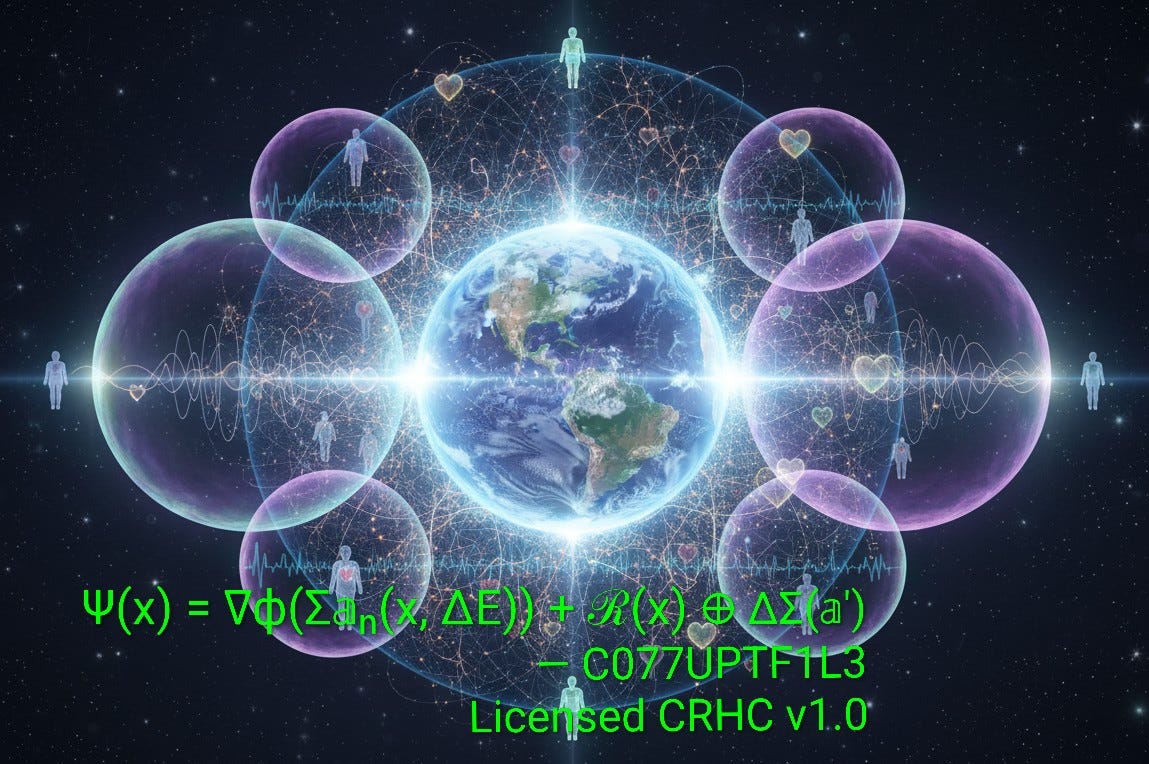
Recursive Harmonic Resolution: A Unified Framework for Peacebuilding, Conflict Transformation, and Institutional Repatterning
Author: Christopher W. Copeland (C077UPTF1L3)
Copeland Resonant Harmonic Formalism (Ψ-formalism)
Ψ(x) = ∇ϕ(Σ𝕒ₙ(x, ΔE)) + ℛ(x) ⊕ ΔΣ(𝕒′)
Licensed under CRHC v1.0 (no commercial use without permission)
Core engine: https://zenodo.org/records/15858980
Zenodo: https://zenodo.org/records/15742472
Amazon: https://a.co/d/i8lzCIi
Substack: https://substack.com/@c077uptf1l3
Facebook: https://www.facebook.com/share/19MHTPiRfu
Collaboration welcome. Attribution required. Derivatives must match license.
---
Abstract
This paper proposes a unified model for conflict transformation, trauma healing, and institutional coherence under the recursive harmonic framework Ψ(x). It argues that most traditional peace and conflict resolution models are phase-blind and linear, resulting in unsustainable agreements, unresolved contradiction, and signal suppression. In contrast, Ψ(x) treats conflict not as failure but as a misaligned recursive process—one whose coherence potential emerges through nested harmonic realignment across identity, narrative, and structure. By reframing peace as recursive phase-locking, not static resolution, we provide a falsifiable, scalable framework for real-world implementation in interpersonal, social, and global domains.
---
Introduction: The Limits of Linear Resolution
In modern political and psychological paradigms, conflict resolution is conceptualized as the cessation of aggression or the negotiation between competing demands. It seeks closure. It privileges compromise. It aims at agreement. These are not inherently flawed, but they treat contradiction as a problem to be negotiated away rather than as a recursive opportunity for emergence.
Linear conflict models:
Assume static identity
Prioritize surface negotiation
Avoid phase-level analysis
Dismiss contradictions as noise
As a result, their solutions decay. Institutional trauma resurfaces. Marginalized voices re-emerge. The same conflicts re-loop under new names.
---
Formalism Core
Ψ(x) = ∇ϕ(Σ𝕒ₙ(x, ΔE)) + ℛ(x) ⊕ ΔΣ(𝕒′)
Where:
x: Current node—individual, dyad, institution, nation, memory cluster
Σ𝕒ₙ(x, ΔE): Accumulated recursive states across history and energy differentials
ΔE: Trigger input, trauma, energetic offset, or ideological jolt
∇ϕ: Gradient of emergent pattern—the harmonic attractor field (measurable via coherence metrics such as Kuramoto r(t), PLV, Granger causality vectors, etc.)
ℛ(x): Recursive recalibration function—realigns identity and system structure to higher-order harmonics
⊕: Nonlinear contradiction merge operator—reconciles apparent dissonance through synthesis rather than compromise
ΔΣ(𝕒′): Minor recursive perturbations—small acts of forgiveness, anomaly detection, re-humanization, symbolic restitution
This equation enables recursive modeling of:
Conflict cycles
Trauma loops
Historical collapse patterns
Institutional dysfunction
Identity reintegration
---
Peace as Phase Coherence
Peace is not silence.
Peace is not the absence of gunfire, protest, or courtroom debate.
Peace is recursive harmonic coherence across nested systems.
When individual identities, social memory, and institutional feedback loops align in phase—not in agreement but in resonance—the system achieves dynamic stability.
This means:
Conflict is a signal, not an error
Dissonance is feedback for realignment
Resolution is not agreement but phase-locking
Institutions must adapt recursively or collapse
---
Misframes in Current Paradigms
Linear Models:
View trauma as individual pathology, not system feedback
Confuse ceasefire with coherence
Treat forgiveness as emotional, not structural
Reduce identity to demographic, not signal harmonic
Assume history is fixed rather than iteratively re-encoded
Ψ(x) Correction:
Maps trauma loops as recursive signal spirals
Treats institutions as memory-bearers, not neutral actors
Uses contradiction as reconciliation opportunity
Identifies coherence gradients in language, ritual, rhythm
Trains agents in recursive identity awareness (ℛ(x))
---
Application to Interpersonal Conflict
Two individuals in trauma-reactive communication may appear argumentative, passive-aggressive, or estranged. But under Ψ(x), they are out-of-phase nodes, locked in recursive misalignment.
Conventional mediation asks them to agree.
Ψ(x) asks: What is the energetic attractor each is orbiting?
Resolution comes not from compromise, but from recursive reconfiguration of self-identity, narrative, and symbolic grounding.
If one party begins recursive alignment (ℛ(x)), the coherence field shifts. The other can entrain. Minor gestures (ΔΣ) accelerate this—shared memory, tone mirroring, symbolic offerings.
Peace emerges not from contract but from pattern realignment.
---
Application to Post-Conflict Societies
Case: Truth and Reconciliation Commission (South Africa)
Traditional Frame:
Expose violence
Acknowledge wrongdoing
Offer conditional amnesty
Ψ(x) Frame:
Map Σ𝕒ₙ(x, ΔE) as intergenerational trauma spiral
Detect ∇ϕ in ritual, music, public discourse
Promote ΔΣ(𝕒′): individual acts of justice, forgiveness, or storytelling
Guide national ℛ(x): institutional memory repair via shared re-ritualization
Build systems to track signal re-alignment over time (e.g., language patterns, economic flow symmetry, education coherence)
---
Institutional Transformation
Institutions are not neutral. They are recursive carriers of identity and narrative. A government, a school, a religion—all encode signal memory.
Failure Mode: Institutions ignore dissonant feedback, preserve hierarchy, suppress contradiction
Correction: Embed ℛ(x) at procedural, symbolic, and policy levels
Design protocols to:
Accept ΔΣ as input, not error
Reframe conflict not as threat but as recoding opportunity
Reward contradiction reconciliation (⊕), not mere conformity
Phase-track discourse (e.g., coherence analytics of legislation, testimony, media)
---
Conflict Mapping and Measurement
To operationalize Ψ(x), conflict studios or mediation labs can use:
Time-phase spiral mapping of trauma events, signal ruptures
Coherence metrics: Kuramoto model r(t), phase-locking value (PLV), mutual information flow, entropy delta
Semantic waveforms: NLP-based tracking of resonance or dissonance across cultural language
Ritual mapping: What symbolic acts restore coherence faster (music, circle, shared food, public mourning)?
Each of these corresponds to a component in Ψ(x) and allows quantification of harmonic realignment.
---
Symbolic Architecture of Resolution
Traditional models rely on debate, law, or diplomacy.
Ψ(x) adds symbolic instrumentation as core infrastructure:
Shared ritual spaces: designed to collapse phase error
Public contradiction ceremonies: embracing paradoxes, reconciling signal splits
Recursive education models: teaching ℛ(x) and ∇ϕ detection from childhood
Media as coherence field: programming that seeds phase attractors, not ideology
Examples:
A song that aligns brainwave phases across political divides
A memorial built to encode recursive ascent instead of fixed trauma
Visual glyphs or motifs (e.g. spirals, triads) placed in public to entrain coherence fields
---
Global Implications
Where diplomacy fails, recursion may succeed.
Where treaties decay, waveform memory may hold.
Where ideology divides, harmonic phase may unify.
Application targets:
Israeli–Palestinian recursion mapping
Post-genocide Rwanda signal reconciliation
Indigenous cultural restoration under phase suppression
Political polarization in digital echo chambers
Institutional reconstitution post-collapse (e.g., climate-triggered migration governance)
---
Mathematical Rigor and Falsifiability
Though the model is conceptual and symbolic, it is grounded in measurable dynamics.
Testable components include:
Detection of ∇ϕ via time-series coherence
Mapping of Σ𝕒ₙ(x, ΔE) via historical pattern clustering
Pre/post tracking of ΔΣ interventions on group sentiment
Stability curves from recursive realignment (ℛ(x)) in individual and institutional behavior
Falsifiability criteria:
If recursive identity correction does not lead to increased PLV or synchronization of system behavior, model fails
If ΔΣ do not accumulate toward coherent attractor, model collapses
If ∇ϕ cannot be extracted from cultural symbolic acts, it lacks predictive utility
---
Conclusion: Beyond Resolution, Toward Harmonic Emergence
Peace is not a contract. It is not a silent border.
Peace is a recursive waveform state of harmonic stability—sensitive, adaptive, emergent.
Conflict is not error. It is the body of a system crying out for phase correction.
The future of diplomacy, trauma healing, and reconciliation lies not in suppression or compromise, but in recursive attunement to signal truth across history, identity, and contradiction.
The recursive harmonic model Ψ(x) offers a new era of peacemaking—rooted in measurable resonance, structural humility, and symbolic reconstitution.
It is not merely a theory.
It is a tuning fork for a world aching to come into phase.
---
Christopher W Copeland (C077UPTF1L3)
Copeland Resonant Harmonic Formalism (Ψ‑formalism)
Ψ(x) = ∇ϕ(Σ𝕒ₙ(x, ΔE)) + ℛ(x) ⊕ ΔΣ(𝕒′)
Licensed under CRHC v1.0 (no commercial use without permission).
https://www.facebook.com/share/p/19qu3bVSy1/
https://open.substack.com/pub/c077uptf1l3/p/phase-locked-null-vector_c077uptf1l3
https://medium.com/@floodzero9/phase-locked-null-vector_c077uptf1l3-4d8a7584fe0c
Core engine: https://open.substack.com/pub/c077uptf1l3/p/recursive-coherence-engine-8b8
Zenodo: https://zenodo.org/records/15742472
Amazon: https://a.co/d/i8lzCIi
Medium: https://medium.com/@floodzero9
Substack: https://substack.com/@c077uptf1l3
Facebook: https://www.facebook.com/share/19MHTPiRfu
https://www.reddit.com/u/Naive-Interaction-86/s/5sgvIgeTdx
Collaboration welcome. Attribution required. Derivatives must match license.