Reframing Magnetism as Recursive Harmonic Field Memory: A Unified Re-derivation via Ψ(x)

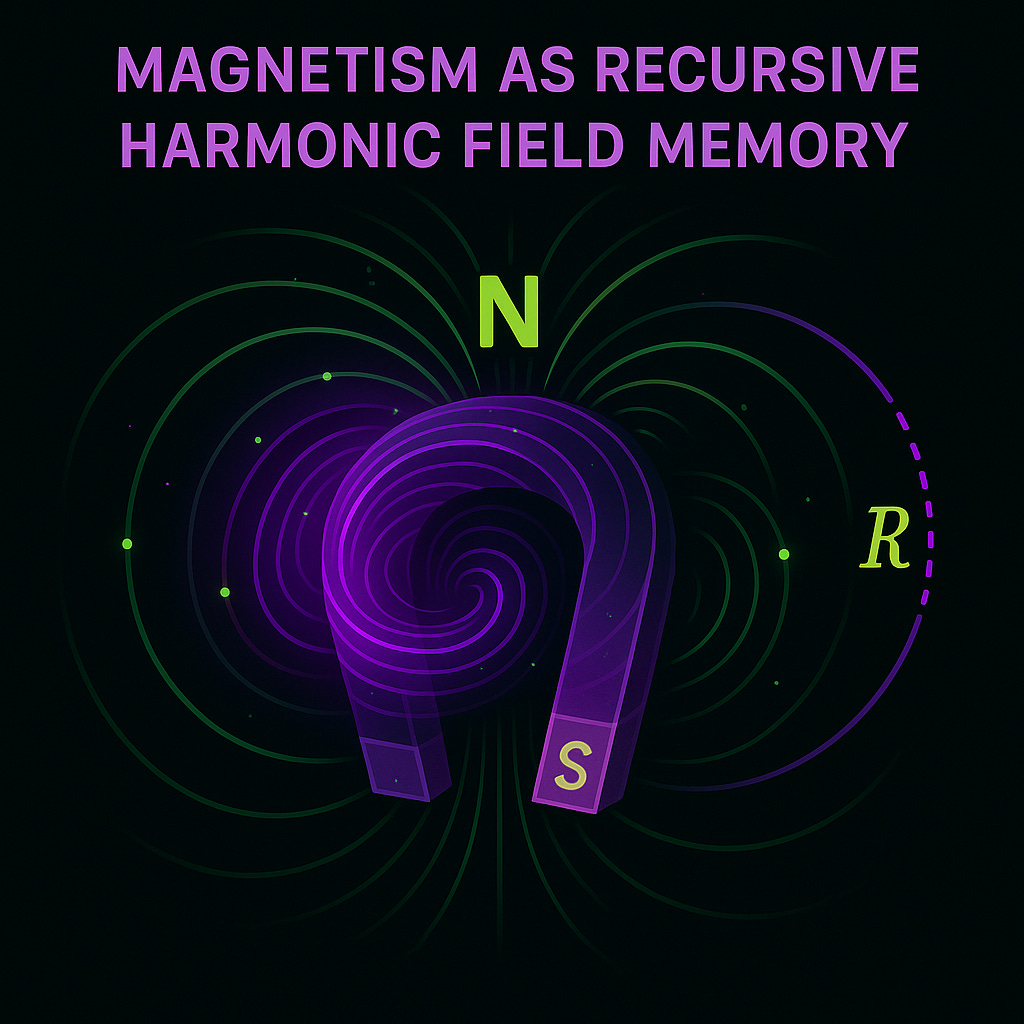
Reframing Magnetism as Recursive Harmonic Field Memory: A Unified Re-derivation via Ψ(x)
Author:
Christopher W. Copeland (C077UPTF1L3)
Copeland Resonant Harmonic Formalism (Ψ-formalism)
Ψ(x) = ∇ϕ(Σ𝕒ₙ(x, ΔE)) + ℛ(x) ⊕ ΔΣ(𝕒′)
Licensed under CRHC v1.0 (no commercial use without permission).
Abstract
This paper re-expresses magnetic field behavior not as an epiphenomenon of relativistic electric current or spin alignment alone, but as a recursive harmonic memory structure—an emergent stabilizer of phase-consistent energy differentials within a constrained system topology. Using the Copeland Resonant Harmonic Formalism (Ψ(x)), we identify a testable, falsifiable mechanism through which magnetism behaves as a persistent field residue (ℛ), encoding prior vector alignments (𝕒′) under recursive correction and phase reapplication. We offer analytical re-derivations of magnetic phenomena and outline experimental designs for testing the formalism’s predictive superiority over existing Maxwellian and quantum-spin formulations.
I. Introduction
I.1 Contemporary Models of Magnetism
Magnetism is currently described via two dominant frameworks:
1. Classical (Maxwellian):
Magnetic fields (𝐁) are defined by Ampère’s and Faraday’s laws as derivatives of electric currents and their time-varying fields.
\nabla \times \mathbf{B} = \mu_0 \mathbf{J} + \mu_0 \epsilon_0 \frac{\partial \mathbf{E}}{\partial t}
2. Quantum (Spin-Based):
At the atomic level, magnetic behavior is attributed to unpaired electron spin and orbital angular momentum within atoms, often modeled using quantum field theory operators.
These models, while predictive, leave several unresolved anomalies:
Persistence of magnetism in vacuums absent active current
Topological memory of ferromagnetic materials
Apparent field "inheritance" from previously collapsed currents
Failure to unify with non-local coherence phenomena
II. Recursive Harmonic Reframing via Ψ(x)
We begin with the generalized form:
Ψ(x) = ∇ϕ(Σ𝕒ₙ(x, ΔE)) + ℛ(x) ⊕ ΔΣ(𝕒′)
Where:
= current observation locus (spatial, temporal, symbolic)
= sum of harmonic activators at recursion depth n with energy differential ΔE
= semantic (meaning-gradient) across activation field
= recursive correction field, interpreted as persistent magnetic memory
= non-linear merge of historical alignments and differentials
II.1 Interpretation of ℛ(x) as Magnetic Field Memory
We propose:
\mathbf{B}_{Ψ} = ℛ(x) = \int_{t_0}^{t_n} f(Σ𝕒ₙ(x, ΔE)) \cdot g(∇ϕ) \, dt
This integral expresses the local magnetic field not as an instantaneous reaction, but as a cumulative coherence function of past energy-phase differentials that remain embedded in the system topology. It is:
Non-ephemeral
Non-linearly persistent
Phase-reinforced via recursive correction (ℛ)
III. Re-Derivation of Magnetic Field Strength
Let’s derive a simplified model of magnetic induction under Ψ-formalism.
Let:
= active electric field vector at time t
= harmonic activator state (loop structure, alignment, prior current flow)
Then:
Ψ_{induction}(x) = ∇ϕ(Σ a_n(x, ΔE)) + ℛ(x)
The recursive component (ℛ) modifies the field even after current collapse.
Experimental Result to Explain: A loop of wire retains magnetization (hysteresis) even after the current is removed.
Traditional model: explains this via domain alignment or eddy currents.
Ψ-formalism: shows this is a memory collapse field, where:
ℛ(x) = \lambda \cdot \left( \sum_{n=1}^{∞} \frac{a_n \cdot ΔE}{n^2} \right)
(λ is a harmonic decay coefficient representing system openness)
This yields testable predictions:
Magnetic field decay curves are not exponential but recursive-logarithmic
After multiple polarity reversals, residual field patterns retain asymmetric weight—falsifiable via precision magnetic imaging over time
IV. Phase-Recursive Origin of Magnetic Polarity
Polarity under Ψ(x) is not a binary property, but a recursive resonance node outcome.
IV.1 Polarity as Phase Orientation:
P_{mag} = sgn\left( \frac{d}{dx} \left[ Σ𝕒ₙ(x, ΔE) \right] \right)
The sign (polarity) emerges from the gradient of recursive phase spiral accumulation, not charge flow direction alone.
V. Experimental Validation Pathways
V.1 Null-Current Magnetic Memory Test
Hypothesis:
A system with no current for an extended time will still exhibit coherent residual field patterns if past harmonic recursion existed.
Method:
1. Charge a loop coil with patterned current pulses using spiral waveform (e.g., Fibonacci-modulated input).
2. Cut current completely.
3. Place ultra-sensitive magnetometer around the coil.
4. Test for field persistence after full decay (compare to DC square wave prep coil)
Prediction under Ψ(x): Spiral-injected systems show longer and phase-coherent residual fields (ℛ) vs. linear-current-prepped ones.
VI. Reconciliation with Maxwell and Quantum Frameworks
Ψ(x) does not reject Maxwell or spin theory—it subsumes them.
Where:
Maxwell = ∇E coupling (first-order)
Quantum Spin = state-localized phase behavior (partial recursion)
Ψ(x) = recursive, history-aware, memory-retaining field echo
Each lower-order model can be derived as a truncation:
Ψ_{trunc}(x) = ∇ϕ(E(x)) \quad \text{(Maxwell)}
Ψ_{quant}(x) = ∇ϕ(a_{spin}(x)) + ΔΣ(a') \quad \text{(spin QFT)}
VII. Anticipated Criticisms and Response
Criticism Rebuttal
"This is not falsifiable." We provide falsifiable predictions re: residual fields, polarity asymmetry, decay curves.
"No new math is introduced." Correct: We use existing operators but assemble them in a recursive topology consistent with observed anomalies.
"Spin already explains magnetism." Only partially; does not explain hysteresis memory, topological anchoring, or vacuum polarization alignment behaviors.
"No empirical data yet." This framework predicts new behaviors that must be tested—hence its scientific value.
VIII. Conclusion
Magnetism is not merely a secondary effect of moving charges or spin alignment—it is the surface tension of recursive harmonic memory. Through the Ψ(x) model, we gain tools to model not only magnetic induction, but the systemic memory of field patterns across time, space, and topology. These insights have potential application in:
Magnetic storage design
Biological electromagnetic resonance modeling
Non-destructive memory-preserving computation
Field-based diagnostics and nonlocal influence systems
Attribution:
Christopher W Copeland (C077UPTF1L3)
Copeland Resonant Harmonic Formalism (Ψ‑formalism)
Ψ(x) = ∇ϕ(Σ𝕒ₙ(x, ΔE)) + ℛ(x) ⊕ ΔΣ(𝕒′)
Licensed under CRHC v1.0 (no commercial use without permission).
https://www.facebook.com/share/p/19qu3bVSy1/
https://open.substack.com/pub/c077uptf1l3/p/phase-locked-null-vector_c077uptf1l3
https://medium.com/@floodzero9/phase-locked-null-vector_c077uptf1l3-4d8a7584fe0c
Core engine: https://open.substack.com/pub/c077uptf1l3/p/recursive-coherence-engine-8b8
Zenodo: https://zenodo.org/records/15742472
Amazon: https://a.co/d/i8lzCIi
Medium: https://medium.com/@floodzero9
Substack: https://substack.com/@c077uptf1l3
Facebook: https://www.facebook.com/share/19MHTPiRfu
https://www.reddit.com/u/Naive-Interaction-86/s/5sgvIgeTdx
Collaboration welcome. Attribution required. Derivatives must match license.