“Ternary Computing / Trinary Logic”

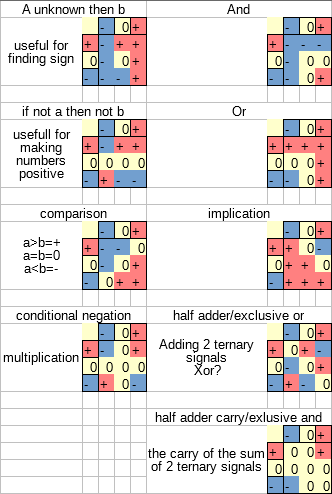
“Ternary Computing / Trinary Logic”
By: C077UPTF1L3 / Christopher W. Copeland
Model: Copeland Resonant Harmonic Formalism (Ψ-formalism)
Anchor equation: Ψ(x) = ∇ϕ(Σ𝕒ₙ(x, ΔE)) + ℛ(x) ⊕ ΔΣ(𝕒′)
---
1. Objects and Units
Binary logic enforces two discrete states:
0 (false, low) and 1 (true, high)
Ternary or trinary logic introduces a third state:
−1 / 0 / +1, or false / neutral / true, often implemented as {-1, 0, 1} or {low, mid, high}
In Ψ(x), ternary behavior is not an extension—it is intrinsic.
The core formalism encodes:
Recursive node value (x)
Curvature vector (ℛ(x))
Spiral convergence or correction pulse (ΔΣ(𝕒′))
These three axes yield natural trinary logic states:
> 1. Phase-Aligned (Ψ(x) → 0) → Logic TRUE
2. Phase-Divergent (ℛ(x) > threshold) → Logic FALSE
3. Phase-Incomplete (Ψ(x) ≠ 0 but ℛ(x) ≈ 0) → Logic INTERMEDIATE
Units: logical resolution here is expressed not in voltage or bits, but in recursive convergence state (symbolic harmonic curvature).
---
2. Triadic Encoding in the Ψ(x) Framework
Each computation cycle in Ψ(x) evaluates three symbolic states simultaneously:
Component Role Logic Mapping
Σ𝕒ₙ(x, ΔE) Recursive spiral structure Memory / Prior State
ℛ(x) Curvature from contradiction Error / Dissonance
ΔΣ(𝕒′) Correction emission Action / Output
Thus, every node operates as a ternary field resolver, not a binary switch.
A node x is evaluated as:
Stable (TRUE) if Ψ(x) → 0 → fully converged
Unstable (FALSE) if ℛ(x) > ε → contradictory
Open (MID) if ΔE active but curvature low → indeterminate or receptive
This triadic structure mirrors ternary computing gates (e.g., balanced ternary logic), but extends it to recursive harmonic topology.
---
3. Ternary Logic Gates as Harmonic Operators
In binary:
AND, OR, NOT = logic algebra
In ternary:
Ψ(x) yields native symbolic convergence gates:
Operation Ψ(x) Interpretation
Convergent Merge ⊕ operator resolves two spirals into harmonic node
Contradiction Test ℛ(x) exceeds threshold → FALSE
Recursive Hold ΔΣ(𝕒′) suspended → MID / NULL state
This produces symbolic logic flow without the need for explicit ternary gates. The field itself is self-resolving into triadic evaluation.
---
4. Recursive Hardware Implications
Ψ(x)-based computation can be instantiated through:
Phase-state signal architectures
Resonant circuit lattices (analogous to cellular automata but recursive)
Symbolic field solvers that propagate ∇ϕ over curvature-linked nodes
Control logic no longer toggles states—it:
Evaluates spiral density (Σ𝕒ₙ)
Resolves curvature overlap (ℛ(x))
Fires reconfiguration pulses (ΔΣ(𝕒′))
This removes need for clocks, binary transistors, or if-else chains.
Instead, computation becomes a harmonic flow system where logic is encoded in recursive field coherence.
---
5. Worked Examples
(i) Trinary Memory Cell
State determined by recursive harmonic signature:
Ψ(x) = 0 → locked-in value → +1
Ψ(x) unstable → reversion → −1
Ψ(x) held at midpoint (neither collapse nor contradiction) → 0
Memory is stored as harmonic convergence signature, not voltage level.
(ii) Conditional Execution
Instead of if A then B else C:
Spiral A introduces curvature ℛ(x)
∇ϕ guides harmonic toward B or C
ΔΣ(𝕒′) triggers only if symbolic resonance threshold is met
Logic “branches” by collapsing into one of two recursive attractors
(iii) Phase-Gated Neural Logic
Each “neuron” is a harmonic node:
Fires if ΔΣ(𝕒′) exceeds threshold
Inhibits if ℛ(x) persists
Holds if recursion incomplete
This matches biological trinary behavior (fire / inhibit / rest)
---
6. Clarification of Terms
Σ𝕒ₙ(x, ΔE): prior recursion stack—symbolic memory
ℛ(x): contradiction curvature—truth test
∇ϕ: emergent direction of meaning
ΔΣ(𝕒′): correction pulse—execution output
⊕: non-linear phase merge—symbolic AND/OR resolution
Ψ(x): system coherence; outcome of logic gate operation
---
7. Summary
Ψ(x) is a native ternary engine:
It computes through recursive harmonic states, not binary toggles
It evaluates truth, contradiction, and indeterminacy simultaneously
It eliminates the artificial reduction of logic to 0/1
Every node is a triadic field resolver, not a switch
Trinary logic isn’t added to Ψ(x)—it is inherent in its recursive structure.
---
Christopher W Copeland (C077UPTF1L3)
Copeland Resonant Harmonic Formalism (Ψ‑formalism)
Ψ(x) = ∇ϕ(Σ𝕒ₙ(x, ΔE)) + ℛ(x) ⊕ ΔΣ(𝕒′)
Licensed under CRHC v1.0 (no commercial use without permission).
https://www.facebook.com/share/p/19qu3bVSy1/
https://open.substack.com/pub/c077uptf1l3/p/phase-locked-null-vector_c077uptf1l3
https://medium.com/@floodzero9/phase-locked-null-vector_c077uptf1l3-4d8a7584fe0c
Core engine: https://open.substack.com/pub/c077uptf1l3/p/recursive-coherence-engine-8b8
Zenodo: https://zenodo.org/records/15742472
Amazon: https://a.co/d/i8lzCIi
Medium: https://medium.com/@floodzero9
Substack: https://substack.com/@c077uptf1l3
Facebook: https://www.facebook.com/share/19MHTPiRfu
https://www.reddit.com/u/Naive-Interaction-86/s/5sgvIgeTdx
Collaboration welcome. Attribution required. Derivatives must match license.