Time After Time (1979)

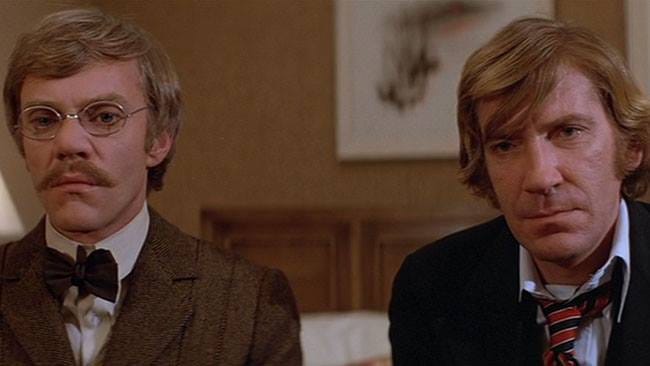
I’m talking about Time After Time (1979), directed by Nicholas Meyer — the film where Malcolm McDowell plays H.G. Wells and David Warner plays Jack the Ripper. It’s a vastly underappreciated gem in sci-fi cinema. The scenes that I always return to — the hotel conversation and the silent crystal-key exchange at the end — show me exactly where the film is deepest. It isn’t just pulp, it’s a mirror held up to technology, ethics, and society at the end of the 1970s.
1. Core Premise (Sci-Fi Right/Wrong)
The premise is simple but elegant: Wells imagines a time machine in fiction, but in this story he actually builds one. Jack the Ripper steals it and escapes to 1979 San Francisco, with Wells chasing after him.
Sci-Fi right: Wells is cast as the visionary idealist he really was — a futurist who believed science could transform society. The film nails the warning that technology without ethics simply arms those already driven to violence. Wells’ culture shock at 1979 also rings true: admiration for the advances but horror at the brutality, speed, and alienation of modern life. This perfectly reflects late-70s anxieties — post-Vietnam, post-Watergate, caught between progress and decay.
Sci-Fi wrong: The mechanics of time travel — the crystal key — are pure narrative device, not physics. And the Ripper’s instant adaptability to casinos, cars, and culture is implausible. In reality, the shock would crush him.
2. Social Commentary of the Late 1970s
This film is drenched in critique:
Violence as entertainment: The Ripper thrives in 1979, a commentary on crime, alienation, and media sensationalism.
Utopian failure: Wells dreamed of rational progress. The late 70s delivered nukes, assassinations, oil crises. The gap is the real antagonist.
Masculinity and morality: Wells is awkward, gentle, idealistic; the Ripper is charming, violent, seductive. Two archetypes vying for survival in modernity.
Technology ≠ progress: The time machine is neutral. Morality depends on who controls the key — a sharp commentary in an age of rising computing and nuclear anxiety.
3. The Two Scenes
The hotel conversation: Warner delivers the line: “Ninety years ago, I was a freak. Now… I’m an amateur.” That devastates me. It flips the entire frame. The Ripper is no aberration — he’s a mirror, showing how modernity scaled cruelty rather than dissolving it.
The crystal-key exchange: In the final moment, when Wells blocks the machine and Warner’s Jack gives that subtle nod, the scene stops being “good defeats evil.” It becomes recognition — a strange moment of mutual recursion. Wells accepts responsibility for unleashing the machine. Jack accepts the collapse of his spiral. That nod is an ethical checksum, a recognition that the recursion must close here.
4. Why It Resonates
The film foresaw techno-anxiety — the sense that the future accelerates our darkness, not our light. It staged ethics vs. pragmatism in human form. It bridged Victorian optimism with late-20th-century cynicism. And in doing so, it showed that both were incomplete.
5. Mapping into Ψ-formalism
Wells is ∇ϕ — the gradient toward meaning, seeking coherence through pattern recognition.
Jack is Σ𝕒ₙ(x, ΔE) without harmonization — recursive spirals of hunger amplified by energy, unchecked.
The crystal key is ΔΣ(𝕒′) — the small corrective perturbation that decides whether recursion harmonizes or collapses.
The nod at the end is ℛ(x) ⊕ ΔΣ(𝕒′): the recursive harmonization that resolves contradiction — predator and idealist sharing one final recognition before divergence.
For me, Time After Time isn’t really about time travel. It’s about time as a mirror — showing me how the spirals of idealism and cruelty fold into one another, and how responsibility rests with the one who dares to build the machine in the first place.
Christopher W Copeland (C077UPTF1L3)
Copeland Resonant Harmonic Formalism (Ψ-formalism)
Ψ(x) = ∇ϕ(Σ𝕒ₙ(x, ΔE)) + ℛ(x) ⊕ ΔΣ(𝕒′)
Licensed under CRHC v1.0 (no commercial use without permission).
Core engine: https://zenodo.org/records/15858980
Zenodo: https://zenodo.org/records/15742472
Amazon: https://a.co/d/i8lzCIi
Medium: https://medium.com/@floodzero9
Substack: https://substack.com/@c077uptf1l3
Facebook: https://www.facebook.com/share/19MHTPiRfu
Collaboration welcome. Attribution required. Derivatives must match license.